
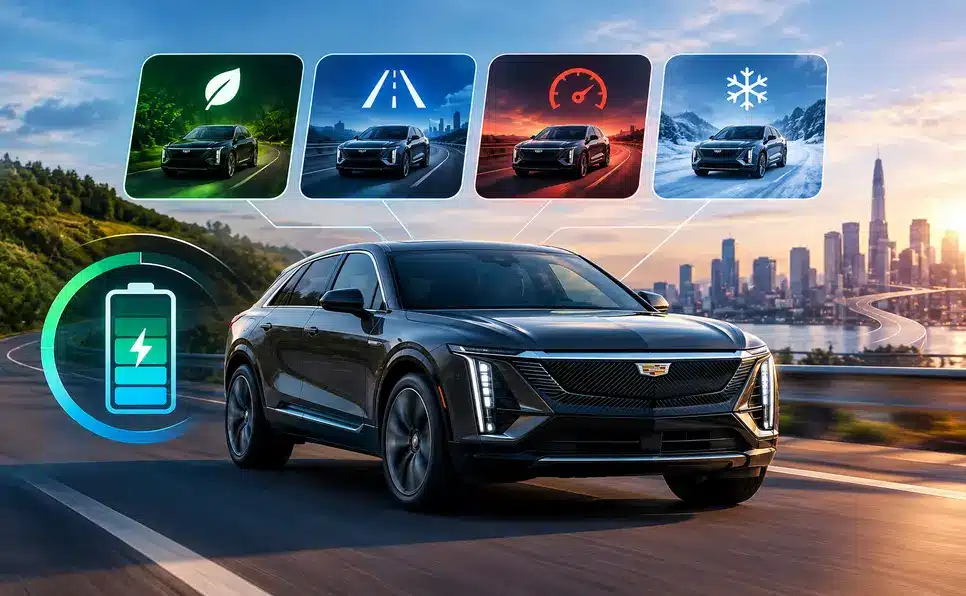
The Cadillac LYRIQ can feel like a slightly different vehicle as you switch driving modes. Tour feels relaxed, Sport makes the response more immediate, and Snow/Ice is there for roads where traction becomes a problem. My Mode adds another layer by allowing several driving characteristics to be adjusted.
That naturally brings up a question that many electric vehicle owners have: do the driving modes in Cadillac LYRIQ offer different ranges or battery usages?
There is a simple answer, but it needs a little explanation. The driving modes do not change the physical size of the LYRIQ battery, and Cadillac does not give each mode its own EPA range rating. What they do change is the way the vehicle responds to the road and the accelerator. That can affect how much electricity is used during an actual trip.
So, if a LYRIQ travels fewer miles in Sport than it did on another day in Tour, that does not mean Sport has a different battery. Driving style, speed, weather, road conditions, and the way the vehicle responds all become part of the equation.
The Short Answer
No separate battery or official range is assigned to each driving mode.
Cadillac currently describes four main LYRIQ driving modes: Tour, Sport, Snow/Ice and My Mode. Tour is intended for everyday driving, Sport gives a more immediate response, Snow/Ice is designed to help reduce wheel spin on slippery surfaces, and My Mode allows the driver to personalize several settings.
The important part is that Cadillac presents these as driving characteristics, not as four different battery settings.
That means a driver should not expect something like:
Tour = 326 miles
Sport = 280 miles
Snow/Ice = 300 miles
Those are not official Cadillac range ratings.
Instead, the same battery is being used differently depending on the situation.
The Battery Does Not Change When the Mode Changes
This is probably the easiest part to clear up.
Switching a LYRIQ from Tour to Sport does not make the battery smaller. Moving into Snow/Ice does not create a separate battery reserve either. The energy stored in the battery remains the energy stored in the battery.
Cadillac’s current specifications list the LYRIQ battery platform at 102 kWh. The same specifications show different EPA range figures depending on the powertrain configuration. For example, the 2027 LYRIQ is listed at up to 326 miles for single-motor rear-wheel-drive models and up to 319 miles for dual-motor AWD models with standard 11.5 kW charging.
Those differences come from the vehicle configuration, not from selecting Tour or Sport.
What can change is the rate at which that stored energy is consumed.
A simple way to picture it is a phone battery. The battery capacity does not change when the phone starts running a demanding application. The battery simply drops faster because the phone is doing more work.
The LYRIQ works on a similar principle.
What Tour Mode Does
Tour is the mode Cadillac describes as the predominant setting for everyday driving. It is tuned around a smooth ride and normal acceleration.
For most daily trips, that makes sense. There is no need for an especially sharp accelerator response when the drive involves traffic lights, errands, commuting, or a normal highway trip.
Smooth acceleration can also help with energy consumption because the driver is less likely to make repeated hard power demands.
That does not mean Cadillac officially promises that Tour will always deliver the longest possible range. Real-world range is affected by many other things, including speed, temperature, terrain, climate control, and driving habits.
Still, Tour is the natural starting point for someone who wants a comfortable everyday driving experience without deliberately asking the vehicle for a sportier response.
For readers interested in the wider technology behind modern vehicles, TechInGot’s AI in Cars: How Smart Vehicles Are Changing Roads also looks at how software, sensors and intelligent systems are changing today’s automotive technology.
What Changes in Sport Mode?
Sport is where the LYRIQ’s personality becomes more noticeable.
Cadillac says Sport is calibrated for a stronger feeling of connection with the road, more immediate torque response, and improved steering at higher speeds.
That immediate response is one of the reasons Sport can use more energy in real-world driving.
It is not because the vehicle suddenly activates a hidden “high consumption” battery setting. The bigger issue is what happens when the accelerator becomes more responsive.
A driver may press the pedal harder or accelerate more often simply because the vehicle makes that kind of driving more enjoyable. Electric motors can deliver strong torque very quickly, so repeated acceleration can pull a significant amount of energy from the battery.
There is an important difference here.
Sport mode can increase energy consumption, but Sport mode does not have a fixed range penalty.
A person could drive gently in Sport and use relatively little extra energy. Another person could drive aggressively in Tour and consume more electricity.
That is why claims that Sport automatically cuts the LYRIQ’s range by a specific percentage should be treated carefully unless they come from a controlled test using the same vehicle, route, weather, and driving conditions.
What Happens in Snow/Ice Mode?
Snow/Ice mode has a completely different purpose.
Cadillac says the mode is intended to help prevent wheel spin on snow and other slippery surfaces. Its driver-mode guide explains that Snow/Ice adjusts the pedal map and slows acceleration and torque response to help control wheel slip.
That softer response can actually feel very different from Sport.
On a dry road, a quick burst of torque can be useful for acceleration. On an icy road, that same burst can make it easier for the tires to lose grip. Snow/Ice therefore focuses more on controlled power delivery.
It should not, however, be treated as an “eco mode.”
If the weather is cold enough to require Snow/Ice, the temperature itself may have a noticeable effect on an EV’s range. Heating the cabin can also increase electricity consumption, and battery temperature can affect how some EV functions operate.
So if a LYRIQ shows less range during a winter trip, the selected Snow/Ice mode is only one small part of the story.
My Mode Is Different
My Mode is probably the most interesting option for someone who does not completely fit into the preset settings.
Cadillac describes My Mode as a customizable experience. Depending on the vehicle and equipment, it can change characteristics such as accelerator responsiveness, steering feel, braking responsiveness, and Electric Vehicle Sound Enhancement.
That means there is no single “My Mode range.”
One driver might configure it to feel relaxed and close to Tour. Another might choose sharper acceleration and a more responsive driving character.
The resulting energy consumption can therefore be different.
This is useful because not everyone wants the same combination of settings. Someone might like the steering feel from Sport but prefer a calmer accelerator response for daily driving. My Mode can provide more flexibility than simply choosing one preset.
Does Sport Actually Drain the Battery Faster?
It can.
But it is worth being precise about what that means.
The LYRIQ does not start draining the battery at a permanently higher rate simply because Sport is selected. Instead, Sport changes the vehicle’s response, and that can influence how the car is driven.
Imagine two identical LYRIQs leaving the same parking lot.
The first driver selects Tour and accelerates gently. The second selects Sport and repeatedly takes advantage of the stronger response.
After several hours, their energy consumption may be quite different.
Now change the example. The first driver stays in Tour but repeatedly accelerates hard, while the second driver keeps Sport selected but drives smoothly. The difference could become much smaller.
That is why driving behavior matters more than the name of the mode alone.
Speed Can Matter More Than the Mode
This is something that often gets lost in conversations about EV range.
A LYRIQ traveling at a steady moderate speed can be much easier on the battery than one being driven quickly with frequent acceleration and braking.
Highway speed, wind, hills, and traffic all change the amount of work the electric motors need to do.
So someone trying to improve range should not focus only on the mode selector. Smooth acceleration and sensible speed can make a bigger practical difference than switching between two modes and expecting an automatic range improvement.
This is also why the EPA range number should be treated as a standardized reference rather than a promise for every journey. Cadillac’s specifications explicitly note that actual range can vary.
Regenerative Braking Is Part of the Picture
The LYRIQ also uses regenerative braking, which changes what happens when the vehicle slows down.
Instead of wasting all of that movement as heat through the brakes, the electric drive system can recover some energy during deceleration and return it to the battery.
Cadillac describes regenerative braking as a way to capture braking energy for added range.
There are limits, though. Cadillac notes that One-Pedal Driving and related regenerative functions can be limited when the battery is extremely cold or hot, or when the battery is close to full.
This matters because regeneration is not simply “free range.” Energy is lost in real-world conversion, and the system cannot recover everything used during acceleration.
Still, smooth driving with useful regenerative braking can help reduce unnecessary energy loss, particularly in situations involving repeated slowing and accelerating.
What About One-Pedal Driving?
One-Pedal Driving is related to efficiency, but it should not be confused with a separate LYRIQ driving mode.
Cadillac explains that One-Pedal Driving allows the vehicle to slow and stop using the accelerator pedal under normal conditions. It offers different levels, including Off, On/Normal, and High.
This can be especially convenient in city traffic because lifting the accelerator can slow the vehicle without constantly moving between the accelerator and brake pedals.
Cadillac also advises against using One-Pedal Driving on slippery roads such as wet, snowy, or icy surfaces.
That is another good example of why EV efficiency should not be reduced to one setting. Driving mode, regenerative braking, road conditions, and driver behavior all work together.
Does the LYRIQ Get the Same Range in Every Mode?
The official answer is that Cadillac does not publish a separate EPA range for every driving mode.
The range figures attached to the LYRIQ are based on the vehicle configuration. Cadillac’s current specifications list different figures for rear-wheel-drive and all-wheel-drive versions.
In actual driving, however, energy consumption can change between modes.
A Sport drive with repeated acceleration can use more energy than a relaxed Tour drive over the same distance. Snow/Ice may change power delivery when traction is poor. My Mode can behave differently depending on how it is configured.
So the most accurate answer is:
The modes can influence real-world battery usage, but they do not have separate official range ratings.
That distinction is much more useful than assigning an exact number of miles to each mode.
Which Mode Makes Sense for Everyday Driving?
For ordinary commuting and general road use, Tour is the straightforward choice.
It is the mode Cadillac describes for everyday driving, with tuning aimed at a smooth ride.
Sport is there when a more responsive driving feel is wanted.
Snow/Ice makes sense when the road is slippery, and traction becomes the priority.
My Mode is useful when the standard choices do not quite match a driver’s preferences.
There is no need to avoid Sport simply because it can lead to higher energy use. The more useful approach is to understand what the mode changes and then drive accordingly.
A Better Way to Think About LYRIQ Range
Instead of asking only, “Which mode gives the most miles?” it helps to look at the whole trip.
A LYRIQ’s energy use can be influenced by:
- Driving speed
- Acceleration habits
- Traffic
- Outside temperature
- Cabin heating or cooling
- Hills and terrain
- Wind
- Tire condition and pressure
- Vehicle load
- Battery temperature
- Regenerative braking
- Selected driving mode
This explains why the same LYRIQ can show different estimated ranges on different days.
For example, a cool spring morning with light traffic may produce a very different result from a freezing winter evening with the heater running and heavy traffic.
The mode selector is only one piece of the puzzle.
A Simple Comparison of the LYRIQ Modes
| Mode | Main Purpose | Possible Effect on Energy Use |
|---|---|---|
| Tour | Everyday driving and smooth response | Often suitable for relaxed, efficient driving |
| Sport | More immediate response and stronger road feel | Can use more energy when the stronger response leads to harder acceleration |
| Snow/Ice | Better control on slippery roads | Energy use depends heavily on weather and road conditions |
| My Mode | Personalized driving settings | Depends on the settings selected |
These descriptions are based on Cadillac’s published descriptions of the LYRIQ’s driving modes. Cadillac does not publish a universal percentage of range loss or gain for each mode, so real-world results should not be treated as fixed numbers.
The Part That Is Easy to Misunderstand
There is a small but important difference between battery usage and range.
Battery usage is about how much electricity the vehicle consumes during a trip.
Range is about how far the vehicle can travel with the available charge.
The two are connected, but they are not identical.
Suppose a LYRIQ uses more energy during one trip because of higher speeds. The battery percentage may fall faster, and the estimated remaining range may drop. That does not mean the battery itself has changed.
Likewise, selecting Sport does not permanently reduce the battery’s capacity. It simply changes the driving experience, and the way the vehicle is driven from that point can influence consumption.
That is the key idea behind the whole question.
What Should a Driver Do If Range Is the Priority?
There is no complicated trick.
Start with Tour for normal driving, keep acceleration smooth, avoid unnecessary high speeds, and pay attention to temperature and climate-control use.
If Sport is preferred, it can still be used. There is no technical reason to avoid it completely. Just keep in mind that frequent hard acceleration can consume more energy.
When roads are genuinely slippery, Snow/Ice should be selected for the reason it was designed: better control and reduced wheel slip.
And if My Mode is being used, the settings can be adjusted to find a comfortable balance between responsiveness and energy use.
The bigger lesson is that efficient EV driving is more about the complete driving pattern than one button on the dashboard.
Final Thoughts
So, do the driving modes in Cadillac LYRIQ offer different ranges or battery usages?
They can lead to different real-world battery usage, but they do not give the LYRIQ different battery capacities or separate official EPA range figures.
Tour is built around everyday driving. Sport provides a more immediate response. Snow/Ice changes power delivery to help on slippery roads, while My Mode allows several driving characteristics to be customized. Cadillac’s own information describes these differences clearly, but it does not assign a fixed range number to each mode.
That is why a claim such as “Sport always reduces the LYRIQ range by a specific percentage” is too simple.
Real-world battery usage depends on what happens behind the wheel. Acceleration, speed, temperature, road conditions, climate control, and regenerative braking can all change the result.
For anyone trying to understand LYRIQ range, the best approach is therefore to look beyond the drive-mode label. The mode changes the vehicle’s behavior, while the entire driving situation determines how much energy the journey actually requires.