
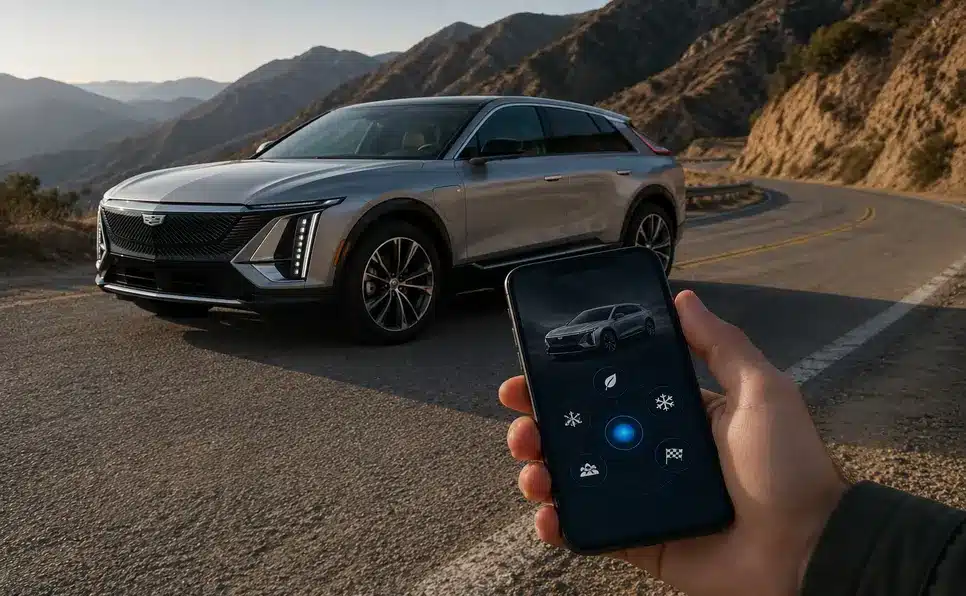
Here is something that surprises many new LYRIQ owners. Two people start the day with the same full charge, the same Cadillac LYRIQ, and the same route, and one arrives home with 40 or 50 more miles showing on the gauge than the other. Same car. Same battery. Same road. One of them used Tour Mode, and the other spent the day in Sport.
That gap is real. It is not a glitch or a display error. This is exactly what the driving modes are designed to do, and understanding it makes a real difference to anyone who drives a LYRIQ regularly.
So, do the driving modes in Cadillac LYRIQ offer different ranges or battery usages? The direct answer is yes. But the way it works is worth understanding properly, because most of the writing on this topic stops at “Tour is efficient and Sport uses more battery,” which is true but only half the story.
Quick Answer
Yes — the driving modes in the Cadillac LYRIQ do not change the physical size of the 102 kWh battery, but they change how fast that battery gets used. Tour Mode gives the longest range and stays closest to the EPA number. Sport Mode typically cuts real-world range by 10 to 25 percent because it invites harder acceleration. Snow/Ice Mode is built for grip, not efficiency. My Mode can go either way, depending on what a driver sets it to.
The Battery Stays the Same No Matter What
Before going into each mode, one thing needs to be clear. The LYRIQ uses a 102 kWh Ultium battery across its main lineup. Switching from Tour to Sport does not shrink the battery saving. Switching to Snow Mode does not drain it faster by itself. What the modes actually change is the software that controls how the vehicle responds when a driver presses the accelerator, turns the wheel, or lifts off the pedal.
Think of it like a garden hose. The water in the tank is always the same amount. But if someone opens the tap all the way rather than halfway, the tank empties faster. The modes control how wide the tap opens, how often it opens, and how much water gets recovered on the way down a hill.
For official range figures, the EPA rates the 2026 LYRIQ at up to 326 miles for the rear-wheel-drive version and 307 miles for the all-wheel-drive version. These numbers are tested in standardized conditions that most closely resemble Tour Mode with minimal climate control, and the EPA’s official testing method explains how these ratings are calculated in the first place. Those are the baseline numbers. Everything else moves up or down from there based on how the car is driven.
Tour Mode: The Everyday Setting
The LYRIQ starts in Tour Mode every time it powers on, and that is not an accident. Cadillac designed it as the mode that gets the most miles out of the battery in normal daily driving, because most people driving on a typical day are not chasing thrills. They are going to work, picking up groceries, or taking the highway for a couple of hours.
Do the Driving Modes in Cadillac LYRIQ Offer Different Ranges or Battery Usages? In Tour Mode, the throttle response is smooth and gentle. Pressing the accelerator halfway does not send the motors into a rush. The power builds steadily, which means the battery releases energy at a calmer, more consistent rate. The steering feels light and easy. The suspension, on versions with Magnetic Ride Control, stays in a more comfortable setting. Everything about Tour Mode is designed to make driving feel relaxed without the driver having to think about it.
The regenerative braking is also active and well-balanced in Tour Mode. When a driver lifts off the accelerator, the electric motors start acting like generators, converting the slowing momentum back into electricity and sending it back to the battery. In stop-and-go city traffic, this process happens dozens of times in an hour, and each small recovery adds up. Careful LYRIQ drivers can actually exceed the EPA range estimate in real-world driving on some routes, especially at moderate highway speeds.
One thing sometimes overlooked is that Tour Mode does not make the car feel slow. The LYRIQ still has plenty of power available. It simply delivers that power in a way that does not encourage wasting it. If you’re weighing an EV against a gas SUV for daily use, our guide on second-hand Honda CR-V options is a useful comparison point for buyers still deciding between the two.
Sport Mode: Where the Fun Starts and the Range Drops
Sport Mode changes the character of the LYRIQ noticeably. The throttle map becomes much more sensitive. A small press of the accelerator brings a strong surge of power almost immediately. The steering gets heavier and more direct. On AWD models, both electric motors stay engaged and ready to push together. If the vehicle has Magnetic Ride Control, the suspension stiffens up for flatter cornering. The whole car feels tighter, quicker, and more alert.
This is genuinely enjoyable to drive. The LYRIQ in Sport Mode feels like a different vehicle compared to its Tour personality. But the range trade-off is real, and it’s the clearest example of how the driving modes in Cadillac LYRIQ offer different ranges or battery usages depending on which one is selected.
Sport Mode doesn’t have some secret drain hiding in the background. The real reason range drops is simple: the pedal becomes touchier. A light press now sends more power. This makes most drivers push harder without even noticing it. And every hard push pulls more energy from the battery.
Owner reports and real-world testing consistently put Sport Mode efficiency roughly 15 to 25 percent lower than Tour Mode on the same route with the same driver. On a car rated for 326 miles, that is a real-world drop of somewhere between 48 and 81 miles, depending on conditions. That is not a small number for anyone planning a longer drive.
Do the Driving Modes in Cadillac LYRIQ Offer Different Ranges or Battery Usages? It is worth noting that a calm, deliberate driver who selects Sport Mode and then drives gently will not see as dramatic a drop. The mode creates the temptation and the capability, but the actual power draw still depends on how the driver responds. The issue is that Sport Mode is specifically designed to make gentle driving feel slightly unusual and responsive driving feel completely natural.
Snow and Ice Mode: Built for Safety, Not Efficiency
Snow and Ice Mode is often misunderstood by drivers who have not needed it yet. This mode is not designed to save range. It is designed to keep the car under control on roads with low grip due to ice, snow, or slush.
In this mode, the throttle softens significantly. Pressing the accelerator sends power to the wheels much more gradually, which reduces the chance of wheel spin on a slippery surface. The traction control and stability systems become more active and respond more quickly. On all-wheel-drive models, the system manages how torque is split between the front and rear axles more carefully to find grip wherever it exists.
The softer throttle can actually reduce the energy spike from hard acceleration, which might make Snow Mode seem more efficient. But it is not primarily an efficiency mode. The extra work done by the traction and stability systems carries its own energy cost. More importantly, cold weather itself has a large effect on EV range that has nothing to do with the selected mode. Battery chemistry slows down in cold temperatures, and heating the cabin in winter requires significant energy. According to the US Department of Energy, EV range can drop 20 to 40 percent in extreme cold, regardless of the selected drive mode.
The honest takeaway is this: Snow Mode is the right choice when road conditions are genuinely dangerous. Using it on dry roads, because it sounds like it might be more efficient, is not the right approach. Once again, this shows exactly why the question of whether the driving modes in Cadillac LYRIQ offer different ranges or battery usages doesn’t have a one-line answer — each mode is built for a different job, not just a different number on the range gauge.
My Mode: The One That Most People Set Once and Forget
My Mode is a customizable setting that lets a driver combine different elements from the other modes. Steering feel can be set separately from throttle response. Suspension behavior, on equipped vehicles, can be tuned independently. The regenerative braking level can be adjusted. The driver essentially builds a personal driving profile and saves it.
How much range My Mode uses depends only on what a driver picks inside it. Set it soft — gentle throttle, light steering, strong regen braking, and it acts almost exactly like Tour Mode in terms of range. Set it sharp — quick throttle, heavy steering, weaker regen and it behaves more like Sport Mode. There is no single answer for what My Mode does to battery usage because it depends completely on the individual settings chosen.
What makes My Mode genuinely useful is the ability to separate elements that are linked together in the preset modes. In Tour Mode, for example, the steering is intentionally light. Some drivers find light steering feels vague or disconnected, especially on faster roads, but they still want the efficiency of Tour’s throttle mapping. My Mode lets them set heavier steering while keeping the efficient throttle. That combination is not available in any of the preset modes.
For range-conscious drivers, the best My Mode setup is usually gentle throttle response combined with maximum or near-maximum regenerative braking, a combination that can sometimes match or even slightly exceed Tour Mode efficiency depending on the driving environment.
The LYRIQ-V: Two More Modes That Change the Picture
The standard LYRIQ has four modes. The LYRIQ-V, which is the performance version of the vehicle, adds two more that standard owners will never see on their screens.
V-Mode sharpens the LYRIQ-V’s responses noticeably beyond what Sport Mode does on the standard car. Throttle sensitivity increases further, the suspension tuning changes, and the overall feel becomes more aggressive. The dual electric motors on the LYRIQ-V produce significantly more combined output than the standard AWD version, and V-Mode makes more of that output immediately accessible.
Velocity Max takes this further still. In this mode, the LYRIQ-V unlocks its full 615 horsepower and prioritizes maximum performance above all other considerations. The range in Velocity Max drops substantially. Cadillac is clear that this is a performance feature, not a driving efficiency tool. The battery management system still protects cell health in this mode, but the energy draw is the highest of any setting available on the vehicle.
For LYRIQ-V owners who want to preserve range, Tour Mode or a conservative My Mode setup remains the sensible daily choice. Velocity Max is genuinely designed for specific performance situations, not everyday commuting.
For more on how the LYRIQ-V compares to the standard model, Cadillac’s official LYRIQ specifications page covers powertrain differences in detail.
What Actually Has the Biggest Effect on Range
Driving modes matter, but they are not the only thing that changes how far the LYRIQ goes on a charge. Several other factors have an equal or greater effect, and understanding them helps a driver make smarter decisions beyond just picking a mode.
Speed is one of the biggest. The energy required to push a vehicle through air increases rapidly as speed rises. Driving at 80 miles per hour uses noticeably more energy than driving at 65 miles per hour on the exact same road. A driver in Tour Mode doing 80 mph consistently may see worse efficiency than a driver in Sport Mode who keeps a steadier 60 mph pace.
Temperature affects the battery chemistry directly. Cold weather slows down the chemical reactions inside the battery cells, which reduces how much usable energy they can deliver. Heating the cabin in winter also draws significant power from the battery. Using the seat heaters and steering wheel heater instead of the main cabin heater is a practical way to stay warm while reducing the energy draw.
Tire pressure has a small but real effect. Low tire pressure increases rolling resistance, which makes the motors work harder to move the car at any speed.
Climate control load matters significantly. Running the air conditioning hard on a hot day adds a meaningful draw to the battery on top of whatever the motors are consuming for driving. Keeping the cabin comfortable without draining the battery is the same challenge gas-car owners solve differently — our piece on car AC coupons and cooling costs covers the non-EV side of that problem.
The One-Pedal Driving feature, which is separate from the driving modes, allows the car to slow down more aggressively when the accelerator is released, recovering more energy in the process. Pairing One-Pedal Driving with Tour Mode in city traffic is one of the most effective combinations for maximizing real-world range. Cadillac explains this feature in detail in its One-Pedal Driving and Regen On Demand guide.
A Simple Scenario Guide
A driver heading out for a 200-mile road trip with no charging stops planned benefits most from Tour Mode and steady speeds below 70 mph. Climate control should be set to a moderate level rather than maximum cooling or heating. One-Pedal Driving helps in any section with traffic. For planning charging stops along the route, PlugShare and ChargePoint are two reliable tools for finding stations in advance.
A driver doing a 15-mile city commute with frequent stops can genuinely use Sport Mode and barely notice a range penalty, because the total energy used on a short trip is small regardless of mode, and the regenerative braking during stop-and-go driving partially offsets the higher draw from sharper acceleration.
A driver facing an icy morning in freezing temperatures should use Snow Mode regardless of any efficiency consideration. The safety benefit is real and significant. Losing some range efficiency is an acceptable trade for staying in control on a slippery road.
A driver who wants the LYRIQ to feel a little more engaging during normal daily use without fully committing to Sport Mode is often best served by a custom My Mode setup with slightly sharpened throttle response but strong regenerative braking and efficient steering, a middle ground that none of the preset modes offer on their own.
A Simple Mode Comparison at a Glance
| Driving Mode | Range Impact | Best Used For |
|---|---|---|
| Tour | Best range, matches EPA estimate | Maximum performance, short-distance use |
| Sport | Roughly 15 to 25 percent reduction | Short trips, spirited driving when charging is nearby |
| Snow and Ice | Moderate reduction, varies with temperature | Icy or snowy roads, low-grip conditions |
| My Mode | Depends entirely on settings chosen | Personalizing a balance between efficiency and feel |
| V-Mode (LYRIQ-V only) | Significant reduction | Performance-focused driving situations |
| Velocity Max (LYRIQ-V only) | Highest reduction of all modes | Maximum performance, short distance use |
Do the Driving Modes in Cadillac LYRIQ Offer Different Ranges or Battery Usages? This table does not come from Cadillac as officially published numbers because Cadillac does not release separate EPA-rated range figures per mode. These ranges come from real-world owner testing and consistent patterns across multiple sources. Actual results will vary based on speed, temperature, route type, and individual driving habits. The table is a useful starting framework, not a precise guarantee.
Frequently Asked Questions
Do the driving modes in Cadillac LYRIQ offer different ranges or battery usages? Yes. Each mode changes throttle response, regenerative braking, and traction behavior, and all of these affect how quickly the 102 kWh battery is used, even though the battery’s capacity never changes.
Does switching driving modes change the Cadillac LYRIQ’s battery size? No. The battery stays at 102 kWh no matter which mode is selected. Only the speed at which that energy gets used changes.
Which LYRIQ driving mode gives the best range? Tour Mode. It keeps acceleration smooth and regenerative braking strong, which is why it comes closest to the EPA-rated numbers.
How much range does Sport Mode actually cost? Real-world testing and owner reports typically show a 10 to 25 percent drop compared to Tour Mode, mainly because Sport Mode encourages harder acceleration.
Is Snow/Ice Mode meant to save battery? No, it’s meant to keep the car stable on slippery roads. It’s not designed as an efficiency mode, though it can feel calmer since the throttle softens.
Can My Mode match Tour Mode’s efficiency? Yes, if it’s set up with gentle throttle response and strong regenerative braking. It’s really a blank slate — the settings decide the outcome, not the mode name.
Does cold weather affect range more than driving mode? Often, yes. Cold temperatures alone can cut range by 20 to 40 percent regardless of mode, because the battery and cabin heater both need extra energy.
The Honest Bottom Line
So, do the driving modes in Cadillac LYRIQ offer different ranges or battery usages? Yes, and that part of the question has a clear answer. But the size of that difference depends heavily on how the driver responds to each mode, not just which mode is selected. A careful driver in Sport Mode may actually outperform an aggressive driver in Tour Mode. The mode shapes the behavior the car invites. The driver still decides how to respond.
Tour Mode is the sensible default for most days. Sport Mode is genuinely enjoyable for short drives or spirited moments when range is not a concern. Snow Mode is the right tool for genuinely difficult conditions and should not be skipped when those conditions exist. My Mode is worth spending 10 minutes setting up properly because a well-configured custom profile can match or beat Tour Mode efficiency while feeling more tailored to how a specific person likes to drive.
For LYRIQ-V owners, Velocity Max exists for a reason and is worth experiencing, but treating it as a daily driver mode is not what it was designed for.
The battery is always the same 102 kWh. The modes change how generously or carefully that energy gets used, and that is a meaningful distinction worth keeping in mind every time the drive mode selector comes into reach. If you’re still shopping around before committing to a LYRIQ, Jeremy Franklin Car Lot is worth a look for comparing dealership options and pricing in your area.