
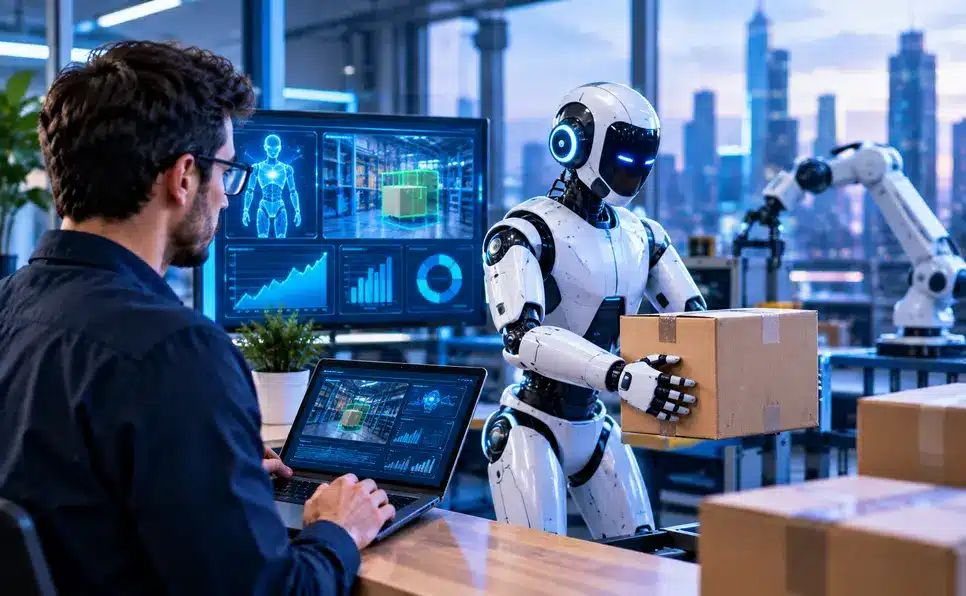
A Tesla factory line that used to build cars is now building humanoid robots instead. Not a side project, an actual conversion, with $20 billion in capital committed to scaling it up in 2026 alone. Meanwhile, a Figure AI factory hit a genuine milestone this June, one robot built every hour, sustained, not a demo, actual production. Something shifted this year. Physical AI stopped being a cool prototype people watched on YouTube and started being a real line item on corporate balance sheets.
Here’s what’s actually driving this, what the honest numbers say, and where robotics and physical AI are realistically headed from here.
What Physical AI Actually Means, and Why It’s Different
Industrial robots have existed for decades, but they’ve always been narrow specialists, welding, palletizing, one repetitive task done the same way every single time.
General-Purpose Machines, Not Single-Task Tools
Physical AI agents, often humanoid in shape, can perceive, understand, and actually navigate unstructured environments instead of following a fixed script. That distinction matters enormously. A traditional robot arm breaks down the moment something unexpected shows up on the line. A physical AI system is built to handle exactly that kind of unpredictability, which is the whole reason 2026 is being called the year pilots turned into production reality, rather than just another year of flashy demos.
The shift isn’t robots getting stronger. It’s robots getting more adaptable, able to work in the same messy, unpredictable spaces humans already operate in every day.
The Costs of this Change are Astronomical!
In 2026’s first half alone, Crunchbase reported $47.4 billion in VC investments into physical AI in 521 deals. By late June, robotics startups had raised $18.8 billion globally, whereas the entire year of 2025 saw startups raise $15 billion in total. The overall physical AI industry is expected to expand at 33.49% CAGR and should attain an estimated $1,145 billion by 2035. One such number is placing physical AI in the fast-growth technology classes anywhere, rather than just in robotics.
Humanoid Robots Are Becoming Genuinely Commercial
This is the part that sounds like science fiction until the actual manufacturing numbers get laid out.
Costs Are Falling Fast Enough to Matter
In 2023, the cost of humanoids ranged from $50,000 to $250,000, but by 2024 it has fallen to $30,000 to $150,000, a decrease of approximately 40% that is directly contributing to the increasing rate at which companies invest in humanoids. Unitree’s units cost about $16,000 apiece, and for smaller manufacturers who might not have been able to afford such automation even in the past, that makes it more of a game-changer.
Real Companies, Real Production Numbers
Tesla is scaling Optimus toward 50,000 units by the end of the year. Figure AI’s BotQ facility is targeting annual production up to 12,000 humanoid robots, and hit that historic one-robot-per-hour sustained rate this past June. Chinese manufacturer AgiBot produced over 1,000 humanoids in 2024 alone, and Morgan Stanley raised its 2026 forecast for Chinese humanoid shipments to 50,000 units, up sharply from an initial estimate of just 14,000 units at the start of the year.
This connects directly to a pattern already visible in how edge AI is reshaping manufacturing more broadly, where the push toward real-time, on-device processing matters just as much for a humanoid robot navigating a factory floor as it does for a stationary industrial sensor.
Where Physical AI Is Actually Deployed Right Now
Manufacturing gets most of the headlines, but the deployment picture spreads across several industries, each for genuinely different reasons.
Manufacturing Is the Clear Leader
By early 2026, 67% of large manufacturers were already testing or actively using physical AI, with efficiency gains reaching as high as 40% in some deployments. Amazon’s “Sequoia” warehouse system alone increased efficiency by 75%. That kind of gain is exactly why manufacturers facing what the industry calls the “Automation Gap,” a persistent global labor shortage, are treating this as urgent rather than experimental.
Healthcare Is Quietly Becoming a Major Frontier
Robotic surgeries now account for 60% of procedures in major hospitals, with systems like Intuitive Surgical’s da Vinci 5 leading that market. Medical robot sales overall jumped 91% year-over-year, reaching 16,700 units sold in a single recent year. Healthcare’s adoption is being pushed by the same workforce shortage pressure driving manufacturing, paired with genuinely high-stakes precision requirements that robotics increasingly meets well.
China Is Playing an Entirely Different Game
China already operates roughly 2 million industrial robots, about 4.5 times more than Japan, the next largest market, and accounted for 54% of all industrial robots installed worldwide in a recent year. China’s newly launched Five-Year Plan places robotics at the center of national industrial policy, setting a formal government target of 59 million humanoid robots in domestic deployment by 2050. That’s not a company betting on robotics. That’s a national government making it an explicit economic strategy.
The Funding Frenzy Behind Individual Robotics Companies
Beyond the aggregate market numbers, specific funding rounds happening right now tell their own story about where investors think this is heading.
Individual Rounds Are Reaching Unicorn Territory Fast
Skild AI raised nearly $1.4 billion in a single round. Apptronik secured a $520 million extension. Wayve raised $1.2 billion at an $8.6 billion valuation. These aren’t small seed rounds for unproven startups. They’re late-stage, high-conviction bets from investors who’ve clearly decided physical AI has moved past the point where waiting for more proof makes sense. Investment in Vision-Language-Action models specifically, the underlying technology letting robots interpret instructions and surroundings together, reached $3.8 billion in 2025, nearly three times the 2023 level.
Even Established Industrial Players Are Restructuring Around This
ABB, a long-established industrial robotics manufacturer, agreed to divest its entire robotics division to SoftBank Group in a deal valued at $5.375 billion. That’s worth sitting with for a second. A legacy industrial robotics leader chose to sell rather than compete directly against the new wave of physical AI-native companies, a signal about how much the competitive landscape has shifted underneath established players who built their business on the older, single-task robotics model. This mirrors a broader consolidation pattern already visible in tech services M&A activity, where established companies increasingly acquire or divest based on whether they can genuinely compete in an AI-native version of their own industry.
The Honest Failures Nobody Should Skip Over
None of this comes without real friction, and pretending otherwise does a disservice to anyone actually planning an investment.
Most Automation Failures Aren’t Really About the Technology
90% of automation failures turn out to be process failures, not technology failures. Companies buy an impressive robot, then discover their actual bottleneck was somewhere else entirely: a broken handoff between departments, inconsistent input materials, or a workflow nobody had actually mapped out before automating it. That statistic alone probably explains more failed robotics investments than any hardware limitation ever could.
Battery Life and Reliability Remain Genuine Constraints
Even leading humanoid platforms from companies like Tesla and AgiBot still face real battery life and reliability challenges that limit sustained, all-day operation. This isn’t a solved problem being downplayed for marketing purposes. It’s an active engineering constraint that shapes how these robots actually get deployed in practice right now, similar to the caution worth applying to any bold technology claim before building a strategy around it, checking what’s actually proven in production versus what’s still aspirational.
Admittedly, Some People Do Not Agree on the Timeline
The May 2026 IFR analysis is much more cautious; it’s still mostly in the demonstrator or pilot phase in the real world, with full commercialization happening later in the planning period, not so soon. That’s a reasonably less optimistic interpretation of the venture funding data than it sounds, and it’s best not to take a stance on either meaning of those words, but rather both.
What Businesses Should Actually Do Before Investing
For any company evaluating a physical AI or robotics investment, a few practical steps matter more than chasing the most impressive-looking demo available.
Mapping the actual process and bottleneck before buying any robot avoids the single most common failure mode in this entire category. Building what industry analysts call a unified data platform, essentially a digital nervous system connecting the robot fleet to existing business systems, matters just as much as the physical hardware itself, since a disconnected robot sitting on outdated infrastructure delivers far less value than one properly integrated into daily operations. Using digital twin simulation to validate return on investment before committing capital catches problems in a virtual environment that would otherwise show up as an expensive mistake on the shop floor. This same measured, prove-it-first approach echoes similar advice already covered in how AI SaaS platforms should get evaluated before adoption, where rushing deployment without solid groundwork tends to backfire regardless of which specific technology is involved.
Final Takeaway
Physical AI and robotics crossed a real threshold in 2026, moving from prototype demonstrations into genuine, sustained production at companies like Tesla and Figure AI. The venture funding, falling manufacturing costs, and national-level government strategy in China all point toward this being a structural shift rather than a passing trend.
The businesses actually benefiting from this shift aren’t the ones buying the most advanced humanoid robot available. They’re the ones mapping their real bottlenecks first, building the data infrastructure to actually support these machines, and validating return on investment through simulation before committing serious capital, treating physical AI as a genuine operational transformation rather than an impressive piece of hardware to show off.