
If you’ve ever heard someone talk about VR and AR and quietly nodded along while having no idea what they meant, you’re definitely not alone. These terms get thrown around a lot, and honestly, they can sound more complicated than they really are.
Here’s the good news: once you see a few everyday examples, it all clicks pretty fast. So let’s break it down together, nice and simple.
Let’s Start With the Basics
Both VR and AR are ways technology can change what you see. That’s really the heart of it. The big difference is how much of your view they change.
Think of it this way:
- Virtual Reality (VR) takes you somewhere else entirely.
- Augmented Reality (AR) adds something new to the world you’re already in.
That’s it. That’s the core idea. Everything else is just details. Let’s look at each one a little closer.
What Is Virtual Reality, Really?
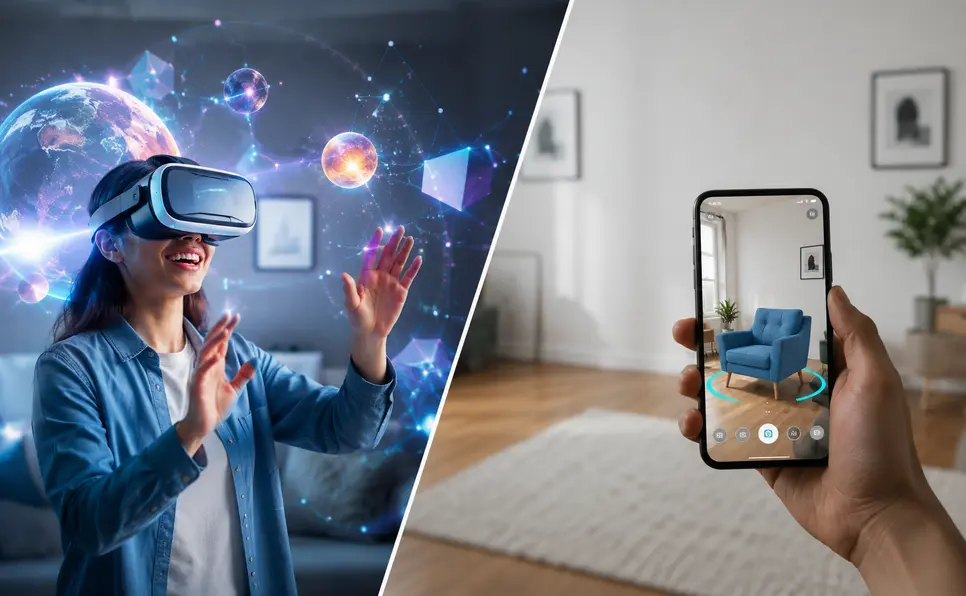
Virtual Reality is like stepping through a door into a completely different world. When you put on a VR headset, the real room around you disappears from view. Instead, you see a whole new environment that’s been created just for that experience.
Picture this: you put on a VR headset, and suddenly you’re standing on a rooftop, or exploring a spaceship, or playing a game where you’re dodging arrows in a medieval castle. Turn your head, and the world around you turns too, just like it would in real life. Except none of it is actually there.
That’s the magic of VR. It replaces your surroundings.
A relatable example: Think about VR gaming. Someone playing a VR boxing game isn’t just pressing buttons on a controller. They’re literally throwing punches in their living room, while the headset makes it look and feel like they’re in a boxing ring. Their body is at home, but their mind (and eyes) are somewhere completely different.
VR is often used for:
- Gaming and immersive entertainment
- Virtual travel or exploring places you can’t visit in person
- Training simulations, like flight training or medical practice
- Watching movies on a giant “virtual” screen, even if you’re sitting on your couch
The key thing to remember: with VR, the real world disappears, and a new one takes its place.
What Is Augmented Reality, Then?
Augmented Reality is a bit different, and honestly, you’ve probably already used it without even realizing it.
Instead of replacing your world, AR adds digital stuff on top of the real world. You’re still looking at your actual living room, your actual street, or your actual face in the mirror, but with something extra layered on top.
A relatable example: Remember those fun filters on Snapchat or Instagram that put bunny ears on your head, or add sparkly makeup to your face? That’s AR in action. Your camera is still showing your real face, but the app is adding a digital overlay right on top of it in real time.
Another great example is shopping apps that let you “try before you buy.” Ever seen an app where you point your phone’s camera at your living room, and it shows you what a couch or a lamp would look like in that exact spot? That’s AR helping you picture something new inside your very real space.
AR is often used for:
- Fun social media filters and effects
- Shopping apps that preview furniture, makeup, or clothing
- Navigation apps that show directions right on top of the street you’re looking at
- Games like Pokémon GO, where digital characters appear to be standing in your real neighborhood
The key thing to remember: with AR, the real world stays exactly as it is, and something digital just joins in.
So What’s the Big Difference, in One Sentence?
If you only remember one thing from this whole article, let it be this:
VR takes you somewhere new. AR brings something new to you.
VR is a full escape. AR is a helpful (or fun) addition to what’s already there.
Common Questions People Have
“Do I need special equipment for both?”
For VR, yes, you typically need a headset that covers your eyes and blocks out the real world. That’s what creates the “somewhere else” feeling.
For AR, you often just need a smartphone or tablet. Since AR adds to the real world instead of replacing it, your phone’s camera and screen are usually enough to make it work.
“Can they be used together?”
Sometimes, yes. There’s actually a term for that in-between space called Mixed Reality, where digital objects can interact with your real surroundings in more advanced ways. But for now, just knowing the difference between VR and AR gives you a really solid foundation.
“Which one is ‘better’?”
Neither one is better. They’re just built for different purposes. It’s a bit like asking whether a book or a window is better. A book takes you into a new story, while a window lets you see more of the world you’re already in. Both are useful, just in different moments.
“Is this stuff only for gamers or tech people?”
Not at all. AR shopping apps are used by everyday people picking out furniture. VR is used in schools, hospitals, and job training. Face filters are used by literally millions of casual social media users every day. This technology has quietly become part of normal life, even if the name still sounds futuristic.
Wrapping It All Up
Here’s the simple version, one more time:
- VR (Virtual Reality) puts on a headset and takes you into a brand new digital world, replacing what’s really around you. Great for gaming, virtual travel, and immersive training.
- AR (Augmented Reality) uses your phone or camera to add something digital right into your real, current surroundings. Great for shopping previews, fun filters, and helpful navigation.
Once you see it through everyday examples like gaming, shopping, and social media filters, it stops feeling like confusing tech talk and starts feeling like something you’ve probably already experienced.
Both technologies matter because they solve different problems. Sometimes you want to escape into somewhere new. Sometimes you just want a little extra help or fun added to the world you’re already standing in. VR and AR each do that beautifully, in their own way.
So next time someone mentions VR or AR, you won’t just nod along. You’ll actually know exactly what they mean.