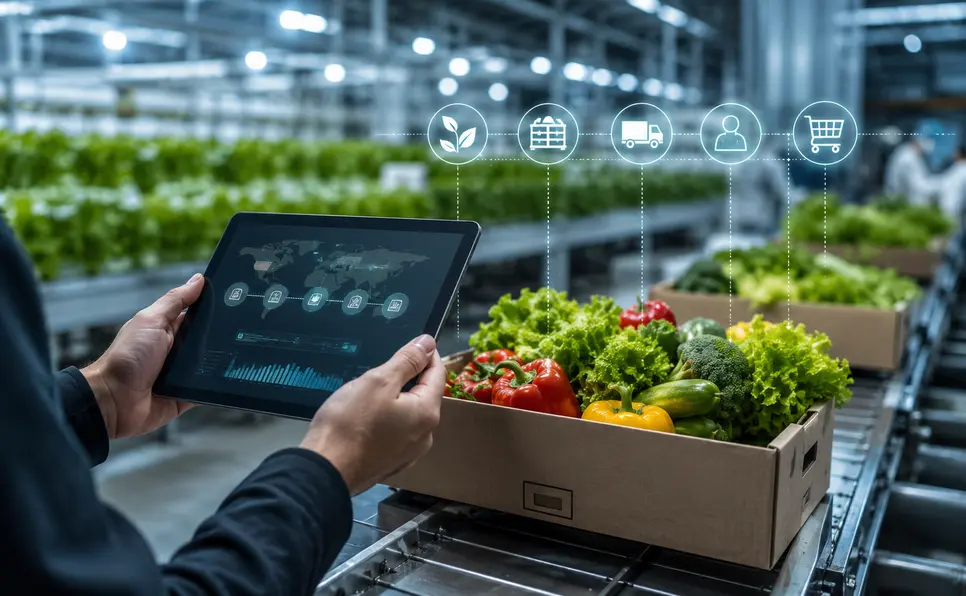
A head of lettuce gets people sick. Health officials need to find the source. Fast. Without good records, they pull every bag of lettuce off every shelf in the country. With good records, they trace the exact farm, the exact field, and the exact shipping date in minutes. That difference is food traceability technology.
This guide breaks down what it is, how it works, and why it matters. No jargon. No filler. Just the facts, explained simply.
What Is Food Traceability Technology?
Food traceability technology is the system of tools used to track food as it moves from farm to plate. It records where food comes from, where it goes, and what happens to it along the way.
Think of it as a paper trail, but digital. Every step gets logged. The farm that grew the crop. The truck that carried it. The warehouse that stored it. The store that sold it.
This tracking system relies on tools like barcodes, QR codes, RFID tags, GPS data, and blockchain records. Each tool captures a piece of the journey. Together, they build a full picture of the supply chain.
The goal is simple: know where your food has been, at any moment, without guesswork.
Why Food Traceability Matters
Food safety is not optional. People get sick from contaminated food every year. Some cases are mild. Others are deadly.
When a foodborne illness outbreak happens, speed matters. The faster a company finds the source, the faster it can stop the spread. Traceability data cuts that search time from weeks to hours.
Here is a real-world example. In 2018, an E. coli outbreak linked to romaine lettuce sickened hundreds of people across the United States. Investigators struggled for weeks to pinpoint the source. Records were scattered. Paper logs did not match up. Many farms had no digital tracking at all.
That outbreak pushed the food industry to take traceability more seriously. Companies realized that slow answers cost lives and money.
Beyond safety, traceability builds trust. Shoppers want to know where their food comes from. They want proof, not promises. A tracking system gives them that proof.
There is also a financial side to this. Food recalls are expensive. A single recall can cost a company millions of dollars in wasted product, lost sales, and legal fees. Traceability limits that damage. Instead of destroying an entire product line, a company can isolate one batch, one farm, or one shipping date. That precision saves money on top of saving lives.
Traceability also supports fair trade and ethical sourcing claims. If a coffee brand says its beans come from a specific farm in Colombia, traceability data can prove that claim is true. Without tracking, that claim is just marketing. With tracking, it becomes a verified fact.
How Food Traceability Technology Works
Traceability is not one single tool. It is a combination of technologies working together. Here is how the pieces fit.
Barcodes and QR Codes
Barcodes are the oldest tool in this space. Every product gets a unique code. Scan it, and you pull up basic details like the product name, batch number, and expiration date.
QR codes do more. Scan a QR code with a smartphone, and you might see the farm name, harvest date, and even a photo of the field. Some coffee brands use QR codes so buyers can see the exact farm that grew their beans.
RFID Tags
RFID stands for radio frequency identification. These tags send data wirelessly, without needing a direct scan.
Picture a pallet of frozen shrimp moving through a warehouse. An RFID tag on that pallet gets read automatically as it passes through different checkpoints. No manual scanning needed. This speeds up tracking and reduces human error.
GPS Tracking
GPS tracking follows shipments in real time. This matters most for perishable goods like meat, dairy, and seafood.
If a truck carrying fresh fish breaks down in the heat for six hours, GPS data flags that delay. Food safety teams can then decide if that shipment is still safe to sell.
Blockchain Technology
Blockchain gets a lot of attention in the food traceability world, and for good reason. It creates a permanent, shared record that cannot be changed after the fact.
Walmart tested blockchain traceability with mangoes. Before blockchain, tracing a mango back to its source farm took nearly seven days. With blockchain, that same trace took 2.2 seconds.
That is not a small improvement. That is a massive shift in speed and accuracy.
IoT Sensors
IoT stands for Internet of Things. These are small sensors placed inside trucks, warehouses, and storage containers. They monitor temperature, humidity, and location around the clock.
If a refrigerated truck carrying dairy products warms up above a safe threshold, an IoT sensor sends an alert immediately. Nobody has to check manually. The system catches the problem on its own.
The Farm-to-Fork Journey
Understanding traceability gets easier when you follow one product through the entire supply chain.
Step One: The Farm
A tomato farm harvests its crop. Each batch gets a code. That code links to details like harvest date, field location, and the workers who picked it.
Step Two: Processing
The tomatoes move to a processing facility. Here, they get washed, sorted, and packaged. The original batch code stays attached, so nothing gets lost in the shuffle.
Step Three: Distribution
A distributor picks up the packaged tomatoes. GPS tracking follows the truck. Temperature sensors monitor the cargo.
Step Four: Retail
The tomatoes arrive at a grocery store. The store scans the barcode, updates its inventory, and puts the product on the shelf.
Step Five: The Consumer
A shopper buys the tomatoes. If that shopper scans a QR code on the package, they might see the farm name and harvest date.
If something goes wrong at any point, this chain of information lets investigators trace the problem back to its exact source. No guesswork. No wasted time.
Who Uses Food Traceability Technology?
This technology is not just for large corporations. Several groups rely on it every day.
Farmers use traceability tools to prove where their crops came from. This matters for organic certification and fair trade labeling.
Food manufacturers use it to track ingredients across multiple suppliers. A single granola bar might contain oats from one farm, honey from another, and almonds from a third.
Retailers use traceability data to manage recalls quickly and protect their reputation.
Government agencies like the FDA use traceability records during safety investigations.
Consumers use traceability apps and QR codes to make informed buying decisions.
Each group benefits differently, but the goal stays the same: clear, accurate information about where food comes from.
Common Challenges With Food Traceability
This technology is not perfect. Several challenges slow down adoption across the food industry.
Cost
Small farms often cannot afford RFID systems or blockchain platforms. Larger companies have the budget. Smaller producers get left behind.
Inconsistent Standards
Different companies use different tracking systems. One supplier might use barcodes. Another might use RFID. When these systems do not talk to each other, gaps appear in the supply chain.
Data Overload
Modern tracking systems generate massive amounts of data. Without the right software, that data becomes noise instead of useful information.
Training
Workers need training to use these systems correctly. A scanner is only useful if someone knows how to operate it properly.
Cybersecurity Risks
Digital tracking systems store sensitive supply chain data. That data can become a target. A hacked traceability database could let bad actors alter batch records or hide the true source of a contaminated shipment. Companies now invest in cybersecurity right alongside their tracking software.
Despite these challenges, the food industry keeps moving toward better tracking. Regulations are tightening, and consumer demand for transparency keeps growing.
New Rules Are Changing the Game
In the United States, the FDA introduced the Food Safety Modernization Act Rule 204, often called the FSMA Rule 204. This rule requires companies handling high-risk foods to keep detailed traceability records.
High-risk foods include items like leafy greens, soft cheeses, and certain seafood. Companies must now track specific data points, including harvest locations, cooling dates, and shipping details.
This rule pushes the entire food industry toward stronger tracking practices. Companies that ignore it risk fines and forced recalls.
Similar rules exist in the European Union, where food traceability has been a legal requirement since 2002 under General Food Law regulations.
Real Companies Using Traceability Technology
Large brands already use these tools daily.
IBM Food Trust is a blockchain-based platform used by companies like Nestlé and Carrefour. It tracks products from farm to store shelf.
Walmart requires many of its leafy green suppliers to use blockchain traceability systems. This came directly after multiple lettuce-related outbreaks.
Starbucks uses a traceability app called Bean to Cup. Customers can enter a code from their coffee bag and see the exact farm that grew those beans.
These examples show that traceability is not a future concept. It is already part of daily food supply chains.
The Future of Food Traceability
Traceability technology keeps evolving. Several trends are shaping where this space goes next.
Artificial intelligence is starting to predict contamination risks before they happen, based on patterns in shipping and storage data.
Smaller, cheaper sensors are making IoT tracking more affordable for small farms, not just large corporations.
Consumer-facing apps are giving everyday shoppers direct access to traceability data, right from their phones.
As these tools become cheaper and easier to use, more of the food industry will adopt them. That means faster recalls, safer food, and more trust between farmers and shoppers.
Interoperable platforms are also on the horizon. Right now, one supplier’s barcode system often cannot talk to another supplier’s RFID network. Industry groups are working on shared standards so every link in the supply chain can read the same data, regardless of which tool captured it. This single change could close many of the tracking gaps that slow down recalls today.
Satellite imaging is another growing tool. Some traceability platforms now combine satellite data with farm records to confirm that crops were actually grown where a company claims. This adds another layer of proof on top of digital paperwork, making fraud much harder to pull off.
Frequently Asked Questions
Is food traceability technology required by law?
In many cases, yes. The FDA’s FSMA Rule 204 requires detailed tracking for specific high-risk foods in the United States. The European Union has required traceability since 2002.
Does blockchain replace barcodes?
No. Blockchain works alongside barcodes, RFID tags, and other tools. Each technology plays a different role in the tracking process.
Can small farms afford this technology?
Costs are dropping. Simple QR code systems are affordable for most small farms. Blockchain and RFID systems remain more expensive but are becoming more accessible each year.
How does traceability help during a food recall?
Traceability data lets companies find the exact source of contamination quickly. Instead of pulling every product off shelves, they can target only the affected batches.
Final Takeaway
Food traceability technology tracks food from farm to fork using tools like barcodes, RFID tags, GPS, blockchain, and IoT sensors. This system protects public health, speeds up recalls, and builds trust between food producers and shoppers.
The lettuce example from the start of this article shows exactly why this matters. Good tracking saves time. Good tracking saves money. Most importantly, good tracking saves lives.
As rules tighten and technology gets cheaper, traceability will keep spreading across the food industry. The farms and companies that adopt it early will stay ahead. The ones that ignore it will fall behind.
Food safety is not a trend. It is a responsibility. Traceability technology is how the food industry keeps that responsibility in check.