
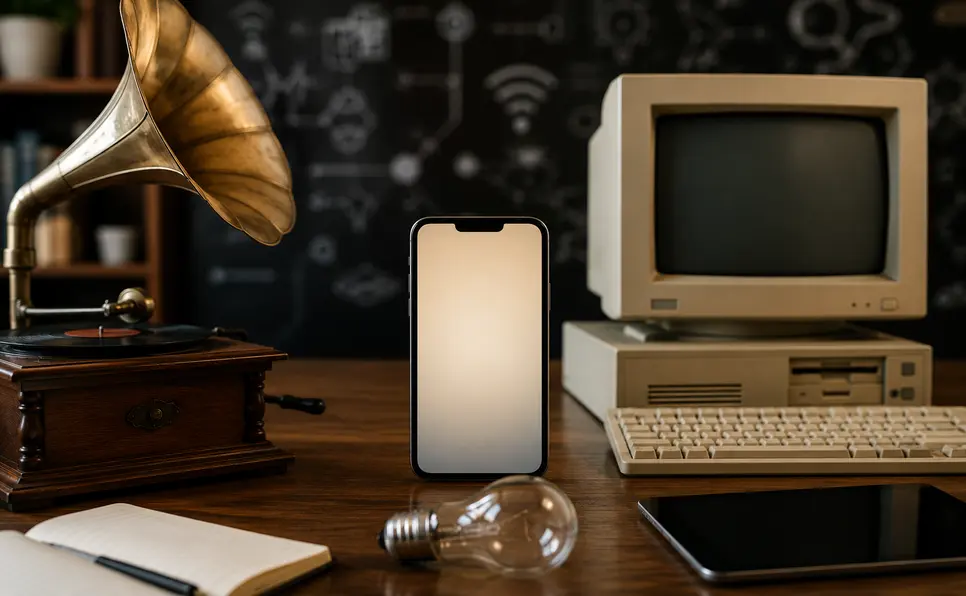
Ask ten people this question, and you’ll likely get ten different answers, and that’s not because anyone is wrong. It’s because “famous” and “important” aren’t quite the same thing, and technology history rarely hands out a single, undisputed winner. Still, if you look at how historians, engineers, and tech writers actually argue this out, a few names come up again and again, and the reasoning behind each one tells you something real about how progress actually works.
So, what is the most famous invention in technology? The short answer most experts circle back to is the printing press, the internet, or the transistor, depending on whether you’re measuring fame, raw impact, or the technology that quietly made everything after it possible. Let’s go through why each of these keeps winning the argument, and where the disagreements actually come from.
The Case for the Printing Press
Johannes Gutenberg’s printing press, developed in the mid-1400s in Germany, is one of the few inventions that historians across very different fields tend to agree on without much pushback. Before it existed, every book had to be copied by hand, which made literacy and education the privilege of a small, wealthy class. Within about fifty years of Gutenberg’s invention, book production didn’t just increase; it exploded. Estimates put the number of volumes in circulation at around 20 million by the year 1500, and roughly 200 million only a decade after that.
What makes this invention so frequently cited as the most important, rather than just one of several major ones, is the chain reaction it set off. Wider literacy fed into the spread of scientific ideas, religious reform, and eventually the conditions that made later inventions possible at all. Several writers covering the history of technology have made a similar point: most other major inventions on any “greatest of all time” list would have struggled to spread, or even exist, without the printing press creating the information infrastructure for ideas to travel in the first place.
The Case for the Transistor
Ask an engineer instead of a historian, and you’ll often get a completely different answer: the transistor. Invented in 1947 by John Bardeen and Walter Brattain at Bell Labs, under the supervision of William Shockley, the transistor doesn’t carry the same instant name recognition as something like the internet or the smartphone. Most people couldn’t tell you what one looks like. But almost every piece of modern electronics, computers, phones, and medical devices, traces its existence back to this one component, replacing the bulky, unreliable vacuum tube.
This is really the core argument in favor of the transistor: fame and foundational importance aren’t the same thing. The transistor isn’t famous the way a finished product is famous. It’s important that the way a building’s foundation is important, mostly invisible, but nothing built on top of it works without it. The personal computer revolution, the rise of the internet, and the modern smartphone all depend on the miniaturization that the transistor first made possible.
The Case for the Internet
Then there’s the internet, which usually wins when the question shifts from “most foundational” to “most famous” in the everyday sense most people mean. Its origins trace back to ARPANET, a U.S. Department of Defense project from the 1960s, long before most people had any idea it existed. It wasn’t until Tim Berners-Lee developed HTTP and, together with Robert Cailliau, built the World Wide Web around 1989 to 1990, that the internet became something the general public could actually use and recognize by name.
The internet’s claim to fame is less about a single eureka moment and more about how thoroughly it reshaped daily life across communication, commerce, education, and entertainment, all within a single generation. It’s also a good example of how invention often isn’t a solo act. Vint Cerf and Robert Kahn’s work on the TCP/IP protocol, which became the internet’s standard networking language, was just as essential as Berners-Lee’s contribution, even though his name gets mentioned far more often in casual conversation.
A Quick Comparison
| Invention | Year / Era | Best Known For | Type of Fame |
| Printing Press | Mid-1400s | Mass production of written knowledge | Historical, foundational to literacy |
| Transistor | 1947 | Replacing vacuum tubes, enabling modern electronics | Technical fame, low public recognition |
| Internet / World Wide Web | 1969–1991 | Global communication and information access | Everyday, household-name fame |
| Smartphone | Early 2000s onward | Combining computer, camera, and phone in one device | Modern, highly visible fame |
| Light Bulb | Late 1800s | Practical electric lighting | Cultural symbol of “invention” itself |
The Disputes Behind the “Famous” Names
Part of what makes this question so hard to settle is that a surprising number of famous inventions come with a genuine ownership dispute attached. Alexander Graham Bell is credited with the telephone, but he filed his patent just hours before a rival inventor, Elisha Gray, filed a similar design, and historians still argue about how much Bell’s design actually borrowed from Gray’s filing. Nikola Tesla and Guglielmo Marconi fought over credit for radio for years, a dispute that was only partly settled, after both men had died, when the U.S. Supreme Court ruled in 1943 that several of Marconi’s key patents were invalid because they overlapped with earlier work by Tesla and others.
These disputes matter for this question specifically because “fame” tends to simplify history into one name, when the reality is almost always a handful of people working on the same problem around the same time, often without knowing about each other. The version of the story that becomes famous is frequently the one that was easiest to tell, not necessarily the most historically accurate one.
Why the Light Bulb Still Comes Up
It’s worth mentioning the light bulb separately, because even though it rarely wins serious “most important” rankings today, it’s arguably the most culturally famous invention there is. The lit bulb above a cartoon character’s head is shorthand for “idea” in pretty much every language and culture that uses cartoons at all. Thomas Edison is usually credited as the inventor, patenting a commercially practical version in 1879, but the historical record is messier than the popular story suggests. Several other inventors, including Humphry Davy, Joseph Wilson Swan, and Warren de la Rue, were working on incandescent lighting before and alongside Edison. What Edison actually did better than his competitors was build a complete, affordable system around the bulb, not just the bulb itself.
This is a pattern that shows up constantly in invention history. The person who gets remembered is often not the first person to have the idea, but the person who made it practical, affordable, or widely available. Edison and the light bulb. Henry Ford and the automobile. Steve Jobs and the smartphone. None of these men invented the underlying concept from nothing, but all three are remembered as the face of the technology because they’re the ones who got it into ordinary people’s hands.
Why There’s No Single Correct Answer
If you’ve noticed a pattern in everything above, it’s this: every answer to “what is the most famous invention in technology” depends entirely on what you’re measuring. Fame in terms of name recognition favors the internet and the smartphone, since billions of people use them daily, and could explain what they do in one sentence. Fame in terms of historical importance tends to favor the printing press, since so much of what came after depended on the spread of recorded knowledge. Fame among engineers and technical historians often favors the transistor, precisely because it’s underappreciated by the general public despite being arguably more foundational than almost anything else on this list.
There’s also a timing problem that historians point out fairly often. An invention’s true significance is sometimes invisible for decades. The transistor didn’t seem world-changing to most people in 1947, just useful in narrow engineering contexts. It took until the personal computer and mobile phone era, decades later, for its full impact to become obvious to anyone outside electronics labs. The same was likely true of the printing press in its early years, well before anyone could see the literacy boom or the Reformation it would help enable.
So, What’s the Honest Answer?
If forced to pick one, most serious lists and historians lean toward the printing press when ranking by sheer downstream impact, since it created the conditions for almost every later invention to spread and build on what came before it. But if the question is really about everyday name recognition, the internet is the answer nearly everyone would give without hesitation, and it’s hard to argue against an invention that the majority of the world’s population now uses daily.
The more honest answer might be that “most famous” isn’t really a single-invention question at all. It’s a layered one, where each layer of technology rests on the one before it, often invisibly. The smartphone in your pocket only works because of the internet. The internet only works because of the transistor. And the transistor’s entire field of electronics only spread as fast as it did because centuries of printed scientific literature had already built the foundation for that kind of collaborative, fast-moving research to happen in the first place.
So when someone asks what the most famous invention in technology is, the most accurate response isn’t really a name. It’s an acknowledgment that fame in invention history is almost always borrowed from something that came before it.