
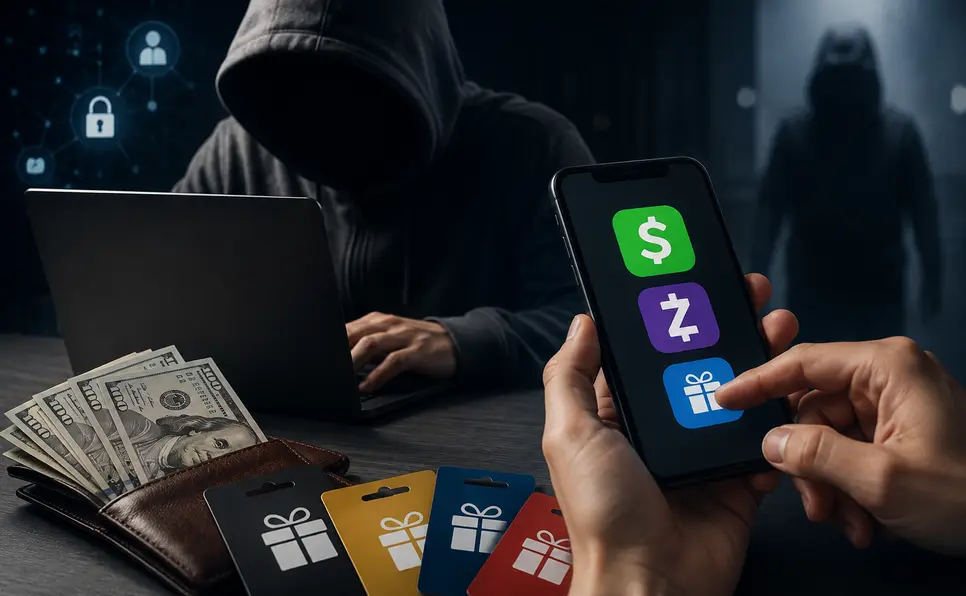
Sending money today takes just a few taps. Cash App and Zelle move funds instantly, and that speed is exactly why scammers love these tools — once money is sent, it is almost impossible to get back.
This guide explains the most common Cash App, Zelle, and gift card scams in simple language, including a specific and frightening one that has been spreading recently: the ListCrawler cartel scam.
Why Scammers Prefer These Payment Methods
Bank transfers and credit cards usually offer fraud protection, so a disputed charge can sometimes be reversed. Cash App, Zelle, and gift cards don’t work that way. Once you send the money, it’s gone.
This is exactly why scammers push people toward these payment methods instead of traditional ones.
Common Cash App and Zelle Scams
1. Fake Support Scams
Scammers pretend to be Cash App or Zelle support agents, often reaching out after someone complains about an online scam. They ask for login details or a “test payment,” which actually sends money straight to them.
2. Accidental Payment Scams
A scammer sends a small payment, then asks for it back “by mistake.” Often the original payment was made with a stolen card. The victim refunds real money, while the fake payment later gets reversed — leaving the victim out of pocket twice.
3. Fake Giveaway Scams
A post claims free cash if you send a small “verification” fee first. No prize ever comes.
4. Romance Scams
After weeks of chatting and building trust, the scammer suddenly needs money for a medical bill, travel cost, or emergency that doesn’t exist.
5. Extortion and Threat-Based Payment Demands
This is where fear, not friendliness, is used to get money fast. One of the clearest examples right now is the ListCrawler cartel scam.
What Is the ListCrawler Cartel Scam?
The ListCrawler cartel scam usually starts after someone contacts an escort ad on ListCrawler or a similar classified site. Later, the person receives a threatening call or text from someone claiming to be part of a cartel, an escort’s manager, or a “boss” of the operation.
The message usually claims:
- You wasted a worker’s time or didn’t show up for an appointment.
- You now owe a “fine.”
- People know your name, phone number, or home address.
- Something bad will happen to you or your family if you don’t pay immediately.
The demand is almost always for fast, hard-to-trace payment — Cash App, Zelle, gift cards, or crypto.
What Do ListCrawler Cartel Threats Look Like?
These threats often follow a pattern:
- Sudden, unexpected contact from an unknown number
- Claims of cartel or gang affiliation
- Mention of personal details to sound convincing
- A short deadline to pay
- Threats of violence if payment isn’t sent right away
The goal is simple: scare you enough that you pay before thinking it through or checking if the story is even true.
Are ListCrawler Cartel Threats Real?
A scary message is not proof that the sender is actually connected to a cartel. Extortion scammers often use frightening names on purpose because fear makes people act fast without questioning anything.
Scammers can also get personal details like your name, number, or address from public records, data breaches, social media, or people-search websites — not from actually knowing you personally.
That said, no one should try to personally judge whether a specific threat is dangerous. If you feel unsafe, contact local police right away.
Why Do They Ask for Cash App, Zelle, or Gift Cards?
Same reason as every other scam on this list — these payments move fast and can’t be undone. Combine that with a short deadline and a scary message, and the victim has very little time to stop and think clearly.
Common Gift Card Scams
Gift cards act almost like cash once the code is shared, which makes them a favorite scam tool.
- Fake tax/utility bill scams demand gift cards to “avoid legal trouble.”
- Fake tech support scams claim your device has a virus and ask for gift card payment.
- Impersonation scams pretend to be a boss, relative, or government official needing urgent gift cards.
Once a gift card code is shared, that money is basically gone.
Warning Signs Across All These Scams
- Urgency and pressure to act immediately
- Requests for gift cards, crypto, or app payments instead of traceable methods
- Unexpected contact out of nowhere
- Refusal to let you verify the claim through an official source
What to Do If You Receive a ListCrawler Cartel Threat or Any Similar Scam Message
- Do not send any money, even a small “good faith” amount.
- Take screenshots of the messages, numbers, and payment requests before blocking anyone.
- Do not argue or negotiate with the sender.
- Verify any “support” contact only through the official app or website.
- Report the incident to the Federal Trade Commission (ReportFraud.ftc.gov) or the FBI’s IC3.gov for extortion/cybercrime.
- If you feel physically unsafe, contact local police immediately.
What If You Already Paid?
- Contact Cash App, Zelle, or the gift card issuer’s official support right away and report it as fraud.
- Report the fraud to the FTC or local consumer protection office.
- Change your passwords and turn on two-factor authentication.
- Do not send more money, even if the scammer keeps asking — extortion demands rarely stop after one payment.
Why These Scams Keep Working
Fast, irreversible payments plus real fear equal the perfect scam formula. Whether it’s a fake giveaway, a romance scam, or a direct threat like the ListCrawler cartel scam, the pattern stays the same: create urgency, demand untraceable payment, and stop the victim from thinking it through.
Frequently Asked Questions
Is the ListCrawler cartel scam real?
The scam itself is real and has affected many people, but that doesn’t mean every sender is actually part of a cartel. Treat it as extortion and report it rather than assuming the threat is guaranteed to be carried out.
Why does the scammer know my address or family details?
This information can come from public records, data breaches, or online profiles — not necessarily from someone physically watching you.
Should I pay to make the threats stop?
No. Paying doesn’t guarantee anything and often leads to more demands.
What payment method do these scammers usually ask for?
Cash App, Zelle, gift cards, or cryptocurrency — all fast and hard to reverse.
Final Thoughts
Cash App, Zelle, and gift cards are convenient, but that same convenience makes them a favorite tool for scammers, including in serious cases like the ListCrawler cartel scam. Knowing the pattern of urgency, fear, and untraceable payment demands is your best protection.