
Updated July 2026
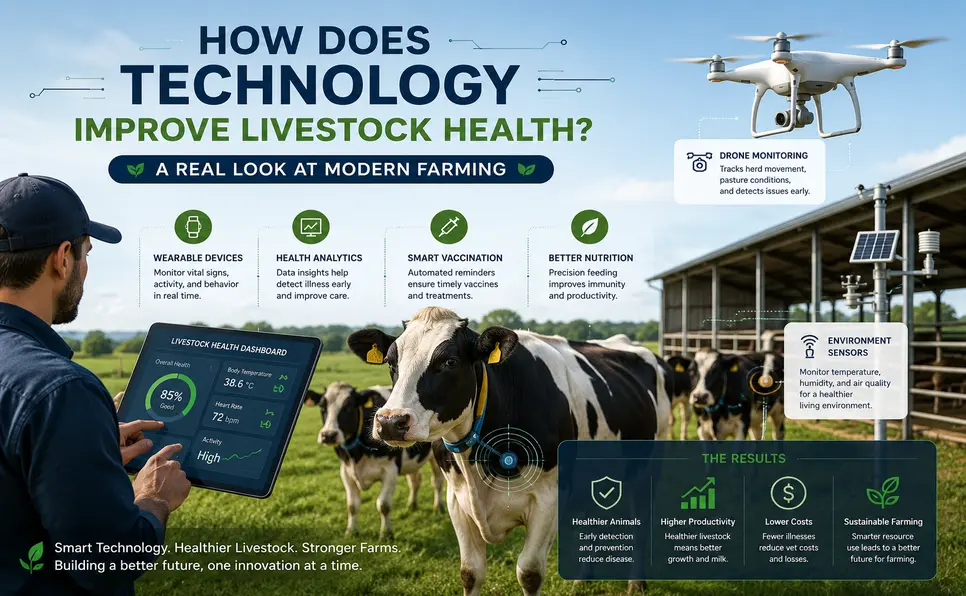
Walk into almost any cattle barn or poultry shed today, and we’ll notice something that wasn’t there ten years ago. A small sensor clipped to an ear. A camera mounted quietly in the corner. A tablet on a fence post showing numbers that update every few minutes. Farming has quietly become one of the more data-driven industries around, and most people outside agriculture have no idea how far it’s come. In fact, when people ask how does technology improve livestock health? These modern tools — often grouped under the term precision livestock farming (PLF) — provide a clear answer by helping farmers monitor animal well-being in real time and respond to potential issues much faster.
If we’ve ever wondered how technology improves livestock health, the honest answer is: in more ways than most people realize, and not always in the flashy way we’d picture. A lot of it is small, practical, and almost unglamorous, but the results are clear in research data. Farmers are catching illnesses earlier, animals are eating better, and vets are spending their time more wisely.
The Old Way of Checking on Animals
Before getting into the technology, it helps to understand what farmers were working with before. For generations, checking on livestock meant walking the field and relying on years of hands-on experience. A skilled farmer can often tell something is wrong just by watching how a cow moves. But there’s a real limitation here: animals are good at hiding weakness. It’s a survival instinct left over from the wild, where looking sick makes us a target. By the time a problem becomes visible, the animal has often already been unwell for a day or two.
This is the exact gap that sensor-based monitoring, remote animal tracking, and smart farming tools have stepped into.
What Wearable Sensors Actually Catch
One of the clearest, most studied examples of this shift is wearable sensor technology — the same broad category covered in our piece on smart wearable technology, just applied to animals instead of people. A widely cited body of research now exists on this, and one detail that stands out is just how early these biosensors and IoT-enabled devices catch trouble compared to a human eye.
In one six-month trial, researchers fitted 50 Holstein dairy cattle with biosensors measuring rumen temperature every ten minutes, sending alerts to the farm manager’s phone whenever a cow’s temperature pattern suggested early mastitis. Out of the cases confirmed by the herd’s own testing, the system generated alert messages closely matching the actual subclinical mastitis incidents that occurred. In a separate, larger study involving 118 cows fitted with ear-mounted 3D motion sensors tracking feeding, rumination, rest, and activity, researchers were able to cross-reference behavioral data against veterinary-confirmed mastitis cases and build a model that flagged at-risk animals before clinical symptoms were obvious.
What both studies point to is the same underlying pattern: cows developing mastitis show reduced motion activity, lower feed consumption, and disrupted social behavior well before a farmer would notice anything by eye. That window, often somewhere between several hours and a full day, is exactly the time a farmer gains by using sensors instead of relying on visual checks alone.
Disease Detection Beyond Just Cattle
This isn’t limited to dairy. Pig farming has its own version of this story. A systematic review covering 83 commercially available precision livestock farming technologies for pigs found that RFID-based monitoring of feeding patterns, used as an early indicator of illness, achieved 97% accuracy in one validation study, though precision was lower at 71%, meaning some false alerts still occur alongside the genuine catches.
That gap matters and is worth being upfront about. Sensor systems aren’t flawless. The same review found that non-contact body-temperature sensors for pigs performed unreliably in one of the studies it examined, which is a reminder that not every monitoring technology lives up to its marketing. Some sensor types work very well; others still need refinement. A farmer evaluating new agtech equipment is right to ask for the actual validation data, not just the product brochure.
The Sheep Industry’s Underused Opportunity
Sheep farming offers an interesting contrast. Researchers studying gastrointestinal nematode infections, a parasitic disease that costs the European sheep industry an estimated EUR 120 million every year, found that infection burden in pregnant ewes was measurably linked to changes in lying behavior, tracked through simple accelerometers. Yet the same research notes that precision livestock farming technology remains underexploited in the sheep sector compared to cattle and pigs. This tells us something useful: the technology clearly works across species, but adoption has been uneven, largely tracking wherever the financial stakes per animal are highest.
Feeding Systems and Precision Nutrition
Smart feeding works on a similar logic. Instead of feeding a herd in broad groups and accepting some animals get slightly more or less than ideal, automated systems calculate intake based on an individual animal’s tag data, factoring in weight, lactation stage, and pregnancy status. This kind of precision wasn’t realistic to do by hand once a herd passed a certain size. It also ties directly into disease prevention, since deviations in normal feeding behavior are one of the most reliable early indicators researchers use to flag a sick animal in the first place.
How Traditional Monitoring Compares to Sensor-Based Monitoring
| Factor | Traditional Visual Checks | Sensor-Based Monitoring |
|---|---|---|
| When illness is typically noticed | After visible symptoms appear | Often hours to a day earlier, based on behavior shifts |
| Labor required | High — manual inspection of every animal | Lower — system flags animals that need attention |
| Accuracy on large herds | Drops as herd size grows | Stays consistent regardless of herd size |
| Cost | Low upfront, higher long-term vet costs from late detection | Higher upfront, often offset by reduced treatment costs |
| Known limitations | Relies entirely on human attention and experience | False alerts possible; not all sensor types are equally reliable |
Wider Effects: Carbon, Climate, and Welfare
Here’s a connection that doesn’t get discussed enough outside academic circles. A modeling study using data from the Scottish Cattle Tracing System examined how precision livestock farming adoption affects greenhouse gas emissions in beef production, comparing housed and grazing systems. The researchers found that technology adoption had a noticeably larger emissions-reduction effect in housed systems than in grazing systems, since indoor herds benefit more directly from tools like automatic weigh platforms and fertility sensors.
Climate stress is another area where this research is active. A study of 102 Italian Holstein cows monitored through three separate five-day heat-wave events in the summer of 2021 tracked milk yield alongside sensor data, identifying animals whose production dropped from heat stress alone, without any accompanying mastitis symptoms, something that would be very easy for a farmer to misdiagnose without behavioral data to cross-check against.
Poultry, Air Quality, and a Disease We Can Smell Before We See
Cattle and pigs get most of the research attention, but poultry farming has its own well-documented angle on this. In a shed holding tens of thousands of birds, checking each one individually is not physically possible. What’s changed instead is environmental monitoring. Ammonia buildup, humidity, and poor airflow are among the most consistent contributors to respiratory disease in poultry, and these are exactly the kind of factors that automated sensors handle well, since they don’t require watching the birds at all. The sensor reads the air, not the animal, and adjusts ventilation before conditions get bad enough to matter.
This is a useful reminder that “livestock health technology” isn’t only about watching animals more closely. Sometimes the bigger win comes from controlling the environment around them, before a health problem even has a chance to start.
GPS Collars and the Problem of Wide Open Land
Not every farm looks like a tidy barn. Many cattle and sheep operations spread across large stretches of land, and animals can wander far from anyone actively watching. This creates real risks: injury, getting stuck somewhere, or simply going missing during calving.
GPS-enabled collars address this directly. A farmer can check a location map and see clusters of animal movement. If a group stops moving for an unusually long stretch, that’s frequently linked to either an injury or an early calving event happening away from the barn. This ties back to the same accelerometer-based behavioral logic used in the mastitis studies above; movement data turns out to be a remarkably useful proxy for health across very different situations.
Why Record-Keeping Matters More Than It Sounds
It’s easy to overlook something as unglamorous as digital record-keeping when discussing flashy sensors, but it plays a real role in the bigger picture. A farmer managing several hundred animals cannot reliably remember which one was vaccinated last spring or which one had a respiratory issue two years back. Farm management software solves this by logging every treatment and illness against a specific animal’s profile.
This matters for the same reason the mastitis research above matters: patterns only become visible if the data is actually tracked over time. If a particular bloodline keeps developing the same recurring issue, a vet or farmer can only catch that pattern if records exist long enough and are organized well enough to compare across years.
Adoption Is Uneven, and That Gap Is Closing Slowly
The sheep industry example mentioned earlier is part of a broader pattern worth repeating: adoption of this technology tracks closely with where the financial stakes are highest per animal, which is part of why dairy cattle research is so far ahead of sheep research. Smaller farms and operations in lower-resource regions have historically been priced out of sensor-based monitoring almost entirely.
That gap is narrowing, gradually. Basic wearable sensors have become noticeably cheaper over the past several years, and some agricultural cooperatives now pool resources to share monitoring equipment across multiple smaller farms in the same region. It’s not a complete fix, and the studies cited throughout this article still draw mostly from larger, better-resourced operations. But it is a meaningful shift, and one likely to keep moving in the same direction as the underlying hardware costs keep falling. Organizations like the Food and Agriculture Organization of the United Nations (FAO) track this kind of technology adoption across regions and continue to publish guidance aimed at closing that access gap for smaller farms.
What This Means for the Vet’s Time, Not Just the Animal
There’s an angle to this that doesn’t get enough attention: veterinarians are a limited resource, especially in rural areas, and sensor-based alerts change how that limited time gets used. Instead of a vet doing routine herd-wide checks where most animals turn out to be fine, the farmer can bring specific, already-flagged animals to the vet’s attention. The research from the pig and dairy reviews above points toward the same conclusion from different angles: monitoring systems are most valuable not because they replace diagnosis, but because they narrow down which animals need diagnosis in the first place.
This has a practical economic effect too. Treating a subclinical mastitis case early, while it’s still manageable with a shorter course of treatment, costs noticeably less than treating a case that’s progressed to visible clinical symptoms, and the cow recovers faster either way. None of the studies cited here claims that sensors eliminate disease. What the data consistently shows is a shift in timing, and in livestock medicine, timing tends to be the single biggest factor separating a quick recovery from a serious, drawn-out illness.
Where the Technology Still Falls Short
It would be dishonest to present this as a fully solved problem. Several of the reviews cited above explicitly flag the same issues: modest sample sizes in many studies, wireless transmission problems in real farm conditions, and devices that perform differently indoors versus outdoors. Cost remains a genuine barrier too, particularly for smaller farms and operations in regions with less access to capital or technical support. The animals that might benefit most from early detection, because veterinary access is limited, are sometimes the least likely to have the equipment that provides it.
None of these tools replaces a vet’s diagnosis or a farmer’s hands-on judgment. What they change is the timing. A farmer who gets a sensor alert at 6 a.m. instead of noticing a limping cow at evening feeding has gained real hours, and in livestock health, hours often decide the outcome.
Frequently Asked Questions
What is precision livestock farming (PLF)? Precision livestock farming is the use of sensors, cameras, and data software to monitor individual animals in real time, rather than relying only on visual checks. It covers wearable biosensors, GPS collars, environmental monitors, and automated feeding systems.
Can wearable sensors really predict illness before symptoms appear? Research suggests yes, in many cases. Studies on dairy cattle have shown that behavior changes like reduced movement and lower feed intake often show up hours to a full day before mastitis becomes visible to a farmer.
Is this kind of technology only useful for large farms? Adoption has historically been concentrated among larger, better-resourced operations, mainly because that’s where the financial stakes per animal are highest. But sensor costs have been falling, and some smaller farms now share equipment through agricultural cooperatives.
Does livestock monitoring technology replace the need for a veterinarian? No. These tools narrow down which animals need attention sooner, but they don’t replace a vet’s diagnosis or a farmer’s hands-on judgment. Their main value is in timing, not in replacing expertise.
Which livestock species benefit most from this technology today? Dairy cattle have the most mature research and adoption, followed by pigs and poultry. Sheep farming remains comparatively underexploited despite research showing clear potential benefits.
Final Thoughts
So, how does technology improve livestock health? When we look past the marketing language and into the actual research? It comes down to earlier detection, more individualized feeding, and data that doesn’t rely on a single person remembering or noticing everything at once. The studies above aren’t perfect or universally conclusive, and the technology has real, documented limitations. But the direction of the evidence is consistent: animals monitored this way tend to get treated sooner, and sooner treatment tends to mean less suffering and lower long-term costs.
That’s really the core of it. Not a futuristic overhaul of farming, but a steady, well-documented improvement in how quickly a problem gets noticed, powered by the same broader wave of IoT, biosensors, and smart monitoring tools reshaping other industries alongside agriculture.