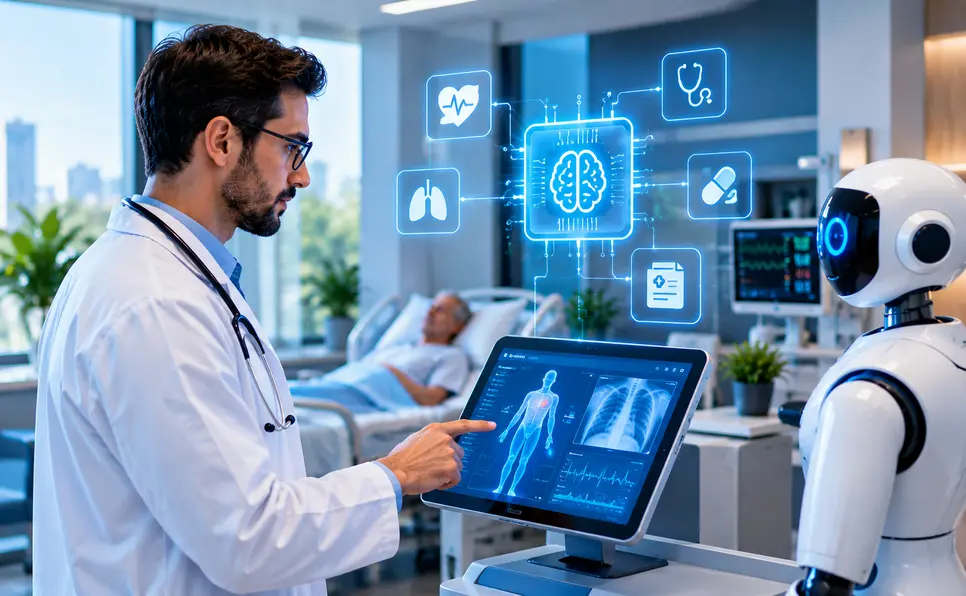
A radiologist looks over a chest scan an AI model already flagged, before she’s even opened the file herself. The system spotted a shadow worth a second look — easy to miss after the fortieth scan of a long shift. She still makes the final call. She just makes it faster, with a second set of eyes that never gets tired. That’s healthcare AI in 2026. Not a far-off promise anymore. A quiet presence sitting inside almost every major hospital system in the country.
Here’s what’s actually happening with AI in healthcare right now, where the real wins are showing up, and where doctors are still drawing hard lines.
Just How Widespread This Technology Has Become
The adoption numbers here are honestly a bit dizzying. They keep climbing faster than most forecasts expected even a year ago.
Physician Use Has More Than Doubled
81% of physicians say they use AI professionally in 2026. That’s more than double the 38% who said the same back in 2023. Family medicine doctors turned out to be the heaviest daily users, with 88% of those who use it at all using it every single day. The most common tasks stay pretty practical, too — literature searches and voice-based AI scribes handling documentation, both up sharply from just a year earlier.
Adoption jumped from 75% to nearly universal in a single year. That speed matters more than any single number, because it means most of healthcare’s AI setup got built in a hurry, not through years of careful planning.
Hospitals Are Running Several Tools at Once
75% of U.S. health systems now use at least one AI application, up from 59% the year before. Half of those systems run three or more tools at the same time rather than leaning on just one. Ambient clinical documentation stands out as the most widely adopted use case of all, with nearly every major health system reporting some level of use.
Where AI in Healthcare Is Actually Delivering Results
Adoption numbers only tell part of the story. The bigger question is where these tools are genuinely improving outcomes, not just adding one more gadget nobody quite trusts yet.
Radiology Is Leading Every Other Specialty
Radiology accounts for 71.5% of all AI and machine learning medical device clearances, and 74% of U.S. hospitals now use AI-powered diagnostic tools specifically within radiology departments. These systems are hitting up to 94% accuracy in tumor detection, edging out human performance in controlled settings. AI-supported hospitals also report a 42% drop in diagnostic errors compared to facilities without these tools. For a broader look at how automated systems are reshaping high-stakes fields beyond medicine, TechInGot’s AI & Machine Learning section covers similar ground across several industries.
Administrative Relief Might Be the Bigger Win
Diagnostic accuracy grabs the headlines, but the administrative side might actually be delivering steadier, day-to-day value. AI chatbots cut patient wait times by up to 50% and trim administrative workload by 30 to 40%. Clinician burnout dropped from 51.9% to 38.8% after short-term use of AI-assisted documentation tools — a genuinely meaningful shift in an industry that’s struggled with burnout for years. Reported return on investment sits around $3.20 for every dollar spent, with payback usually landing somewhere between 12 and 18 months.
The Money Behind This Growth
The global market for AI in healthcare sat around $39 billion in 2025 and is forecast to reach roughly $614 billion by 2034 — a compound annual growth rate near 37%. North America holds the largest regional share at 45%, followed by Europe at 27% and Asia-Pacific at 22%. This kind of fast capital deployment mirrors patterns already seen in how cloud and AI infrastructure spending is reshaping business budgets more broadly, where healthcare sits alongside finance and manufacturing as one of the sectors moving fastest to fund AI at scale. The same rush shows up in how AI is reshaping fintech in 2026, another industry pouring money into automated tools at a similar pace.
Why the Adoption Numbers Hide an Uneven Picture
This part is worth sitting with, since one adoption percentage tends to flatten a much messier reality underneath it.
Documentation Wins Easily. Diagnosis Is a Different Story.
Deployment is close to universal for documentation and back-office work, while genuinely high-stakes diagnosis stays far more limited. Narrow, purpose-built imaging models match or beat human specialists on specific tasks like diabetic retinopathy screening, hitting 90 to 96% accuracy on bounded problems. General-purpose generative AI, by contrast, averages just 52.1% on open-ended diagnostic questions across a large review of studies — closer to a non-expert clinician than a trained specialist. The gap between a narrow tool built for one job and a broad system asked to do everything is enormous, and it’s a distinction most adoption headlines miss entirely.
Bigger Hospitals Move First, Smaller Ones Lag
Adoption tracks closely with resources. Major teaching hospitals adopted generative AI integrated with electronic health records at 53.9%, compared to just 16.3% among independent hospitals working with far less budget and technical staff. That gap mirrors a broader pattern already covered in how smaller businesses are catching up to enterprise AI through subscription-based platforms, where cost and infrastructure, not interest or willingness, remain the real barrier separating early movers from everyone else.
What Physicians Themselves Are Actually Worried About
Adoption statistics rarely capture what the people actually using these tools think about them. That perspective matters here more than almost anywhere else.
Liability Is a Hard Line, Not a Preference
87% of physicians say not being held liable for AI model errors is critical for continued adoption. That’s not a soft concern buried in a survey footnote — it’s described directly as a hard condition, not caution, by the physicians surveyed. Until that liability question gets sorted out clearly, a meaningful share of doctors will keep treating these tools as an assistant to double-check, not a system to fully trust on its own. It’s a reminder that even the smartest software still can’t replace human judgment on its own — something TechInGot has explored more broadly in why technology cannot replace humans.
Skill Loss Worries Are Generational, Not Personal
88% of physicians hold at least some concern about AI-related skill loss, but the worry skews heavily toward the next generation rather than themselves. Only 28% worry about their own clinical skills fading, while 70% are specifically concerned about medical students and residents training today with constant AI assistance, possibly never fully developing the judgment that comes from working through a hard case alone.
Data Privacy Is the One Area Physicians Expect Real Harm
Patient data protection stands out as the single factor where physicians expect net harm from AI rather than net benefit, according to a 2026 physician survey. That’s worth taking seriously given how much sensitive health data flows through these systems. It echoes a broader caution already covered in why security and governance can’t be an afterthought when integrating AI into existing systems, a lesson that applies with even higher stakes in healthcare than almost anywhere else this technology gets deployed.
Where Regulation Is Actually Heading
The FDA had cleared or approved roughly 1,250 AI- or ML-enabled medical devices by mid-2025 — a clear sign that regulation-backed deployment of AI in healthcare has become a real marker of industry maturity, not a bottleneck holding things back. As of January 2026, the FDA released its first draft guidance specifically addressing AI use in drug and biologic development, noting that AI use in regulatory submissions has grown sharply since 2016. No fully AI-discovered drug has been approved yet, though the first approvals are expected within the next few years based on current trial timelines already underway. The pace of this shift echoes how other frontier technologies have moved from lab curiosity to regulated reality — a pattern TechInGot touched on in its piece on quantum computing’s move toward enterprise adoption.
What Healthcare Organizations Should Actually Do
For any hospital or health system deciding where to invest next, a few practical patterns stand out clearly from the data above.
Starting with documentation and administrative workflows offers the clearest, most proven return, given how widely adopted and well-tested these use cases already are compared to newer diagnostic tools. Being honest about the difference between a narrow, purpose-built tool and a general-purpose system matters just as much, since mixing up the two leads to disappointing results when a broad model gets asked to do a job only a specialized one can really handle. And addressing physician liability and data privacy concerns head-on, rather than assuming adoption alone will fix them, builds the trust needed for these tools to move beyond documentation and into genuinely higher-stakes clinical decisions over time.
Final Takeaway
Healthcare AI has moved decisively past the experimental phase, with physician use more than doubling since 2023 and administrative tools delivering real relief from burnout and workload. Radiology and clinical documentation stand out as the clearest proof points, backed by solid accuracy numbers and genuine return on investment, not just hopeful projections.
The uneven part of this story matters just as much as the impressive part. Documentation adoption looks close to universal while high-stakes diagnostic use remains genuinely limited, and physicians themselves are drawing a hard line around liability and data privacy that adoption numbers alone can’t paper over. The health systems getting real, lasting value from AI in healthcare aren’t the ones chasing every new tool that comes along. They’re the ones matching the right kind of AI to the right specific problem, and taking physician concerns seriously enough to actually address them.