
A hospital in Texas rolled out an AI scheduling system to cut wait times. Within a month, patients were furious. The system booked appointments with perfect mathematical efficiency and zero understanding of why a mother needed her child seen before 3 p.m., not after. A human scheduler would have asked. The software just optimized.
That gap, between what a machine can calculate and what a person can understand, is the whole story behind why technology cannot replace humans. This article breaks down exactly where that gap shows up, why it’s not shrinking as fast as headlines suggest, and what it actually means for anyone worried about their job, their industry, or just the direction the world is heading.
The Real Question Behind “Why Technology Cannot Replace Humans”
People searching this topic online, sometimes phrased with a specific brand name attached, like roartechmental, or sometimes just as a plain question, are usually asking one of two things. Either they’re worried about losing a job to automation, or they’re trying to understand where the actual limits of AI and robotics sit right now.
Both are fair questions. The honest answer isn’t “technology will never replace humans” or “technology will replace everyone.” It’s more specific than that. Technology replaces tasks. It doesn’t replace judgment, context, or care, at least not yet, and arguably not ever in the way people fear.
Technology Is Great at Tasks, Not Judgment
Here’s the clearest way to think about it. A task is a defined action with a clear right answer. Judgment is a decision made without a clear right answer, using context a machine doesn’t have access to.
Sorting 10,000 spreadsheet rows is a task. Deciding which of those 10,000 customers deserves a refund exception because their situation is genuinely unusual, that’s judgment. AI can flag the pattern. A human decides what to do with it.
This distinction explains why automation keeps eating tasks while jobs, in a broader sense, keep surviving. A radiologist’s job used to include manually measuring tumors on scans. AI does that measurement now, fast and consistently. But the radiologist still decides what the measurement means for a specific patient’s treatment plan, weighing history, risk tolerance, and context no algorithm was trained on.
Where Human Judgment Still Wins
Emotional Context
A customer service chatbot can process a return request in seconds. It cannot tell that the person on the other end just lost a parent and is asking about a broken product because they’re overwhelmed and need someone to be patient with them. Human agents at companies like Zappos have built entire brand reputations around exactly that kind of emotional reading, something no current AI model reliably does at scale.
Creative Original Thought
AI-generated content is genuinely impressive at remixing existing patterns. It struggles to originate something nobody has made before, because it’s fundamentally built on prediction from existing data. A completely novel art movement, a genre-bending piece of music, a joke that only makes sense because of a specific cultural moment, these things come from lived human experience, not statistical pattern matching.
High-Stakes Ethical Calls
A self-driving car can process road data faster than any human. It cannot weigh a genuinely ambiguous ethical tradeoff the way a human driver instinctively does in a split-second crisis, and current AI systems don’t actually “understand” the moral weight of that decision at all. They calculate probabilities. Understanding and calculating are not the same thing, even when the output looks similar from the outside.
Trust-Based Relationships
People pay premiums for human financial advisors, therapists, and lawyers even when cheaper AI-driven alternatives exist. Trust isn’t purely about accuracy. It’s about feeling understood by another person who has something at stake in the relationship too. A Pew Research Center study on AI and healthcare found that a majority of Americans remain uncomfortable with AI making major decisions about their healthcare, even when told the AI outperforms doctors on certain diagnostic accuracy metrics. Accuracy alone doesn’t win trust.
Real Industries Where This Plays Out
Healthcare
AI already outperforms humans at specific narrow tasks, like detecting certain cancers in imaging scans. But it doesn’t replace doctors, because diagnosis is only step one. A doctor still has to deliver hard news with empathy, adjust a treatment plan around a patient’s actual life circumstances, and catch the rare case that doesn’t fit the pattern the AI was trained on. The technology becomes a tool the doctor uses, not a replacement for the doctor.
Customer Service
Companies that went all-in on chatbot-only support have quietly walked it back after customer satisfaction scores dropped. The pattern repeats across industries: automation handles routine, high-volume requests well, and human escalation paths remain essential for anything emotionally charged or genuinely unusual. Most modern customer service strategies now explicitly design for human handoff rather than trying to eliminate it entirely.
Creative Industries
Design tools, writing assistants, and AI image generators speed up production dramatically. But brand strategy, understanding what a specific audience actually cares about right now, in this cultural moment, still comes from human insight. Agencies use AI to draft faster. They don’t let AI decide what the brand should stand for.
Skilled Trades
An electrician, plumber, or HVAC technician deals with unpredictable physical environments daily, homes built decades apart with completely different wiring standards, hidden pipes, structural quirks no blueprint fully captures. Robotics have made real progress in controlled factory settings. Unstructured, unpredictable environments remain a much harder problem, and skilled trades remain some of the most automation-resistant careers that exist.
Why the “AI Will Replace Everyone” Narrative Gets It Wrong
Part of the confusion comes from how AI capability gets marketed versus how it actually performs in messy, real-world conditions. A demo video shows an AI model performing beautifully on a curated example. Real deployments hit edge cases constantly, and edge cases are where human judgment does its most important work.
There’s also a pattern worth naming directly: some content circulating online, sometimes attached to vague branded terms like roartechmental, presents automation as an unstoppable, inevitable replacement for human work across the board. That framing oversimplifies a much more nuanced reality. Research from MIT’s Work of the Future initiative consistently found that automation reshapes jobs far more often than it eliminates them outright, shifting the mix of tasks a role involves rather than removing the human from the loop entirely.
This matters because fear-based headlines about mass human replacement generate clicks, but they don’t reflect how deployment actually plays out inside real companies, where automation projects frequently underdeliver against their initial promises specifically because the human judgment layer was underestimated during planning.
What Technology Actually Does Well
None of this means technology isn’t valuable. It’s worth being clear-eyed about where it genuinely helps.
Technology handles repetition without fatigue or error drift. It processes volume no human team could match manually. It surfaces patterns buried in data that a person would never spot by eye. It removes drudgery from jobs, freeing people to spend more time on the parts of the work that actually require a human brain.
Research from MIT’s Work of the Future initiative has tracked this pattern across multiple decades of technological change, consistently finding that automation reshapes the task mix within jobs far more often than it eliminates roles outright. That distinction rarely makes it into headlines, but it’s the more accurate picture of how this actually plays out inside real companies.
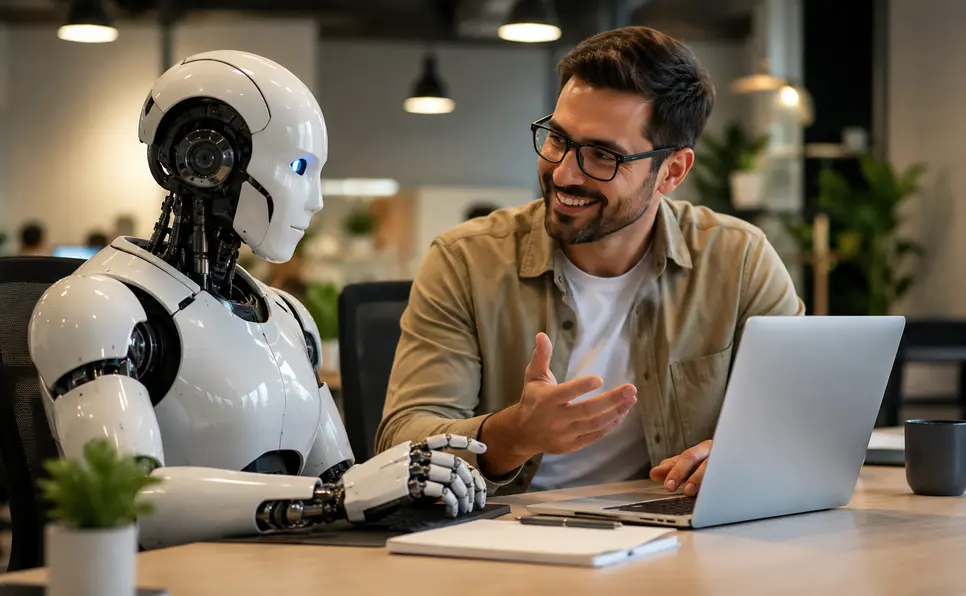
The healthiest way to think about this isn’t humans versus technology. It’s humans plus technology, with technology handling the parts that are genuinely mechanical, and people handling the parts that require context, care, and judgment nobody has figured out how to code.
The History of Overpromising on Automation
This isn’t the first time society has been told machines were about to make human labor obsolete. In the 1960s, experts predicted a fully automated economy by the year 2000, with widespread concern about mass unemployment from factory robotics. That prediction didn’t play out the way it was framed. Manufacturing did automate significantly, but new categories of jobs emerged that didn’t exist before, in software, logistics coordination, and quality assurance roles built entirely around managing the new machines.
The same pattern showed up with the rise of personal computers, then again with the internet, then again with mobile technology. Each wave triggered genuine job displacement in specific roles, travel agents and switchboard operators are real examples, while simultaneously creating entirely new categories of work nobody had a name for a decade earlier. AI and automation are following a similar arc, not a fundamentally different one. The specific jobs at risk change. The underlying pattern of task displacement followed by new judgment-based roles has repeated for over a century.
This history matters because it tempers the more extreme predictions circulating today. When a headline claims a specific percentage of jobs will vanish by a certain year, it’s worth remembering how many similar predictions from past decades failed to materialize in the way they were originally framed, precisely because they underestimated how much judgment, adaptation, and human oversight new systems would still require.
The Cost of Getting This Wrong
Companies that move too aggressively toward full automation without preserving a human judgment layer tend to learn this lesson the expensive way. A well-known example involves a major fast food chain that piloted AI-powered drive-through ordering, only to scale it back after widespread reports of the system mishearing orders and adding items customers never requested, sometimes dozens of times per transaction. The technology worked in controlled testing. Real customers, background noise, regional accents, and last-minute order changes exposed gaps the pilot never accounted for.
This isn’t an argument against using AI in customer-facing roles. It’s evidence for a specific point: technology performs best in messy, real-world conditions when paired with human oversight that can catch what the system misses, rather than being deployed as a full replacement from day one. Companies that treat automation as an augmentation tool, rather than a wholesale replacement strategy, consistently report better outcomes than those chasing full autonomy too early.
What This Means for Anyone Worried About Their Job
If a job consists entirely of repetitive, rules-based tasks with no judgment component, automation risk is genuinely real and worth planning around. But most real jobs, even ones that look automatable from the outside, contain a judgment layer that’s harder to strip out than headlines suggest.
The practical move isn’t panicking about replacement. It’s identifying which parts of a role are task-based versus judgment-based, and deliberately building skill in the judgment side: communication, context-reading, ethical reasoning, and relationship-building. Those are exactly the skills that remain valuable no matter how capable the underlying technology gets.
A simple exercise helps clarify this for anyone unsure where they stand. List out every task involved in a typical workday. Mark each one as either mechanical, meaning it follows clear, repeatable rules, or judgment-based, meaning it requires weighing context that varies case by case. The mechanical list is where automation tools will keep expanding. The judgment list is where career security actually lives, and it’s worth investing deliberate time and training into strengthening those specific skills rather than assuming they’ll simply take care of themselves.
For a deeper technical look at how AI systems actually process information and where their real limitations sit, TechInGot’s guide on AI-powered computer vision in retail shows a concrete example of AI handling detection tasks well while still depending entirely on human staff to interpret alerts and decide how to act on them.
Skills Worth Building as Automation Expands
Given all of this, a few specific skill areas are worth deliberate investment for anyone thinking long-term about career security.
Communication remains difficult to automate convincingly, especially in high-stakes or emotionally sensitive conversations. Practicing the ability to explain complex ideas clearly, listen actively, and read a room stays valuable regardless of how advanced AI tools become.
Cross-disciplinary thinking, the ability to connect ideas across different fields, also resists automation well. AI systems are typically trained within specific domains and struggle to make the kind of unexpected, lateral connections that come from broad human experience and curiosity.
Ethical reasoning and accountability matter more, not less, as automation expands. Someone has to own the consequences when a system gets something wrong, and that responsibility structurally requires a human decision-maker, not just a technical process.
Finally, adaptability itself is a skill worth building directly. The specific tools and platforms in any industry will keep changing. People who treat learning new systems as a core, ongoing part of their job, rather than a disruption to it, tend to navigate technological shifts with far less anxiety than those who don’t.
Frequently Asked Questions
Will AI eventually replace human judgment entirely?
Current AI models predict patterns from training data. They don’t reason about context the way humans do, and there’s no clear technical path toward that changing in the near future, despite marketing claims to the contrary.
Which jobs are safest from automation?
Roles heavy in emotional context, physical unpredictability, or high-stakes ethical judgment, like therapists, skilled trades, and senior medical decision-makers, remain the most resistant to full automation.
Does this mean technology won’t change my job at all?
No. Most jobs will keep absorbing more automated tools for their repetitive components. The judgment-heavy parts of the role are what tend to remain human.
Is “roartechmental” a real company or product?
Available information about this term is inconsistent across different sources, with conflicting descriptions of what it actually refers to. Readers should verify any specific product claims independently before treating them as established fact.
Final Takeaway
Technology keeps getting faster, cheaper, and more capable at specific, well-defined tasks. That’s real, and it’s reshaping nearly every industry. But the reason technology cannot replace humans isn’t nostalgia or wishful thinking. It’s a structural gap between calculation and judgment that current systems haven’t closed, and there’s no clear evidence they’re close to closing it.
The people and companies who come out ahead won’t be the ones fighting automation or the ones blindly trusting it. They’ll be the ones who understand exactly where the line sits, and who double down on the judgment, empathy, and context that no algorithm has managed to replicate yet.