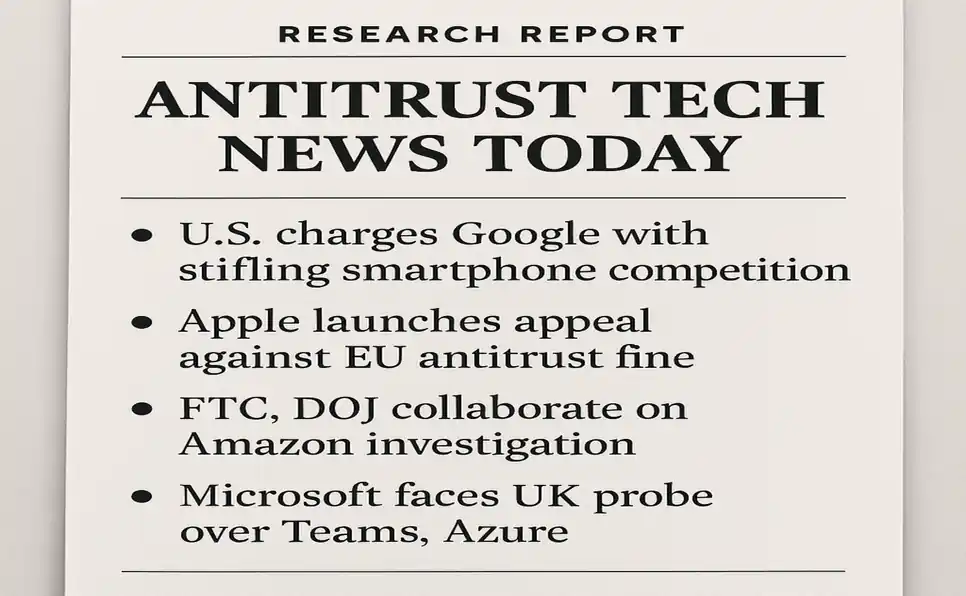
As of August 2026, Big Tech faces its most intense regulatory pressure in decades. Google alone has now lost two separate US monopoly cases — one over search, one over ad tech — with a landmark ad tech breakup decision still pending from Judge Leonie Brinkema. Apple, Amazon, Meta, and Microsoft each face active lawsuits or investigations across the US, EU, India, and beyond, while regulators increasingly turn their attention to AI partnerships and data concentration.
Introduction
The technology sector sits at the center of a new era in antitrust enforcement. Anyone following antitrust tech news today has watched governments and regulators worldwide intensify scrutiny of major technology companies — Google, Apple, Amazon, Meta, Microsoft, Nvidia, and others — through litigation, regulatory investigations, and sweeping new laws. This guide breaks down the most significant antitrust developments shaping the global technology industry in plain language, covering the latest legal actions, regulatory frameworks, and industry responses across the United States, European Union, India, China, and other key jurisdictions. It also looks at what these cases mean for competition, innovation, and the future of artificial intelligence.
Global Overview: The Evolving Antitrust Landscape in Tech
The New Era of Antitrust Tech News Today
The past few years have brought a marked escalation in antitrust enforcement against technology giants. This trend is driven by concerns over market concentration, the gatekeeping power of digital platforms, and the risk that dominant firms could stifle innovation and competition, especially in fast-moving fields like AI and cloud computing. The United States, the European Union, and several national authorities have pursued high-profile lawsuits and investigations, while new regulatory regimes such as the EU’s Digital Markets Act (DMA) and the UK’s Digital Markets, Competition and Consumers Act (DMCC Act) are now fully in force.
A defining feature of today’s landscape is the blending of traditional antitrust enforcement with new, proactive regulatory obligations. The DMA imposes upfront requirements on designated “gatekeepers” to keep competition fair, while the US continues to rely on litigation under the Sherman and Clayton Acts. Cross-border coordination among regulators is also growing, with the EU and Japan formalizing cooperation on digital market rules and other jurisdictions aligning their own approaches.
Political and Economic Context
Political priorities continue to shape the enforcement climate. The second Trump administration has taken a more selective approach to antitrust, prioritizing AI leadership and economic growth, but it has not walked back the major cases already underway against Big Tech. In Europe, enforcement keeps intensifying, with record fines and a stated commitment to sustained action against non-compliant platforms. The resulting transatlantic tension has raised concerns about retaliatory tariffs and a broader trade conflict over digital regulation.
Google (Alphabet): Two Monopoly Rulings and Counting
Google is now the rare company to have lost not one but two separate federal monopoly cases in the same enforcement cycle — a distinction that puts it in the same historical company as the 1990s case against Microsoft.
US Search Monopoly Case and Appeal
In August 2024, US District Judge Amit Mehta ruled that Google had illegally maintained a monopoly in the general search and search advertising markets, largely through exclusive default agreements with device makers and browsers. The court found that Google’s dominance — controlling roughly 90% of the search market — was reinforced by billions in annual payments to partners, creating a self-reinforcing cycle that blocked out competitors.
The remedies phase wrapped up in December 2025. Judge Mehta rejected the Department of Justice’s most severe proposals, including a forced sale of Chrome, but ordered Google to share certain raw search interaction data with qualified competitors and to limit the length of future exclusive agreements. Google filed an appeal in January 2026 seeking to pause these remedies, arguing they would risk user privacy and discourage innovation.
The Second Monopoly Ruling: Google’s Ad Tech Empire
This is where much of the current antitrust tech news today is actually focused, and it’s a case that gets less mainstream attention than the search ruling despite being arguably more consequential for the open web.
On April 17, 2025, US District Judge Leonie Brinkema of the Eastern District of Virginia ruled in United States et al. v. Google that the company had illegally monopolized two separate ad tech markets: the publisher ad server market and the ad exchange market. Her 115-page opinion found that Google tied its publisher ad server (DoubleClick for Publishers) to its ad exchange (AdX) for over a decade, entrenching its dominance and eliminating desirable product features along the way. Notably, the court dismissed claims that Google monopolized the advertiser ad network market and upheld the legality of Google’s earlier acquisitions of DoubleClick and AdMeld.
The case then moved into a remedies trial. Testimony ran through September and October 2025, with closing arguments concluding on November 21, 2025. The Department of Justice, joined by a coalition of states, pushed for structural remedies, including a forced divestiture of AdX to an independent buyer. Google countered with a package of behavioral remedies, including interoperability with third-party bidding tools like Prebid, stopping short of any breakup. Judge Brinkema signaled skepticism about how quickly a structural remedy could realistically be implemented, and as of this update, her final remedies decision remains pending, with most legal observers expecting a ruling sometime in 2026, likely followed by a lengthy appeals process regardless of outcome.
Key Legal Dates and Status:
- January 2023: DOJ and state attorneys general file suit over Google’s “ad tech stack”
- April 17, 2025: Judge Brinkema rules Google illegally monopolized publisher ad server and ad exchange markets
- November 21, 2025: Closing arguments conclude in the remedies trial
- 2026: Final remedies ruling pending; both sides expected to appeal regardless of outcome
Implications:
Rival ad exchanges including Magnite, OpenX, and PubMatic have already filed related damages lawsuits tied to the April 2025 ruling. If Brinkema orders a structural breakup of AdX, it would be the first major forced divestiture ordered against a Big Tech company in decades, reshaping how the roughly $300 billion US digital advertising industry functions. You can read the DOJ’s own statement on the case directly on the Department of Justice’s Antitrust Division press page.
EU and International Investigations: Advertising and AI
In September 2025, the European Commission fined Google €2.95 billion (roughly $3.4 billion) for abusing its dominant position in online advertising technology, finding that Google favored its own ad exchange in the ad selection process. The Commission signaled that only a structural remedy might fully resolve the conflict of interest, though Google has been given a chance to propose alternatives.
In December 2025, the Commission also opened a formal investigation into Google’s use of web and video content to train its generative AI models, including AI Overviews and AI Mode, examining whether the company is using publisher and creator content unfairly without compensation or opt-out options. Japan and India have separately launched their own investigations into Google’s Android pre-installation requirements and its conduct in the smart TV market, while the UK’s Competition and Markets Authority continues to scrutinize Google’s dominance in search and adtech alongside parallel class-action lawsuits.
Implications:
Google now faces a genuinely multi-front regulatory battle across the US, EU, and beyond. Between the ad tech remedies decision, the EU’s adtech fine, and the new AI content probe, the outcome will shape not just Google’s business model but the competitive landscape for AI development more broadly.
Apple: Global Antitrust Pressure and Legal Showdowns
India: CCI Antitrust Case and Penalty Rules Dispute
Apple faces a high-stakes case before India’s Competition Commission (CCI), which found in 2024 that the company had abused its dominant position in the iOS app ecosystem by requiring developers to use its in-app purchase system and restricting alternative payment methods. Apple has challenged the CCI’s penalty framework — which could expose it to fines of up to $38 billion based on global turnover — in the Delhi High Court, but the CCI issued a final warning in December 2025 that it will proceed with enforcement regardless.
United States: DOJ Lawsuit and App Store Litigation
The US Department of Justice, joined by 16 states and the District of Columbia, sued Apple in March 2024 for allegedly maintaining an illegal smartphone monopoly by blocking innovative apps, degrading cross-platform messaging, and suppressing cloud gaming and digital wallets. In June 2025, the US District Court for the District of New Jersey denied Apple’s motion to dismiss, finding the DOJ had plausibly alleged monopoly power (65–70% market share) and exclusionary conduct, sending the case toward trial.
Recent Penalties and Global Actions:
- April 2025: EU fines Apple €500 million for DMA non-compliance (anti-steering in the App Store)
- January 2026: Italy fines Apple $116 million over its App Tracking Transparency policy, alleging the privacy feature is being used as a competitive weapon against rivals
- New Jersey: Apple fined $150,000 for violating a decade-old consent decree, with potential criminal contempt exposure for continued non-compliance
Implications:
Apple is under coordinated pressure across multiple jurisdictions simultaneously. If the DOJ case succeeds, it could force real interoperability and alternative payment options onto Apple’s platform, while the EU and India cases separately chip away at its control over App Store revenue.
Amazon: Marketplace Power, Price-Gouging, and Litigation
In September 2024, a federal judge allowed the FTC’s antitrust lawsuit against Amazon to proceed to trial, currently scheduled for February 2027. The FTC alleges Amazon punishes third-party sellers who offer lower prices elsewhere, pressures them into using its fulfillment services, and manipulates search results to favor its own products.
Separately, in January 2026, US District Judge Richard Jones ruled that Amazon must face a class-action lawsuit alleging it systematically inflated prices on essential goods during the COVID-19 pandemic, both through its own retail division and by failing to prevent third-party price-gouging. The court found Amazon’s algorithmic pricing models could make it directly liable under state consumer protection laws.
Implications:
The price-gouging case is becoming an important test of algorithmic accountability for digital marketplaces more broadly, while the FTC’s marketplace suit could reshape Amazon’s fulfillment and search-ranking practices if it succeeds.
Meta (Facebook): AI Interoperability, Data Silos, and Global Orders
Meta’s push to fold its “Meta AI” assistant directly into WhatsApp has run into a global regulatory wall. In December 2025, Italy’s antitrust authority ordered Meta to suspend terms that excluded rival AI chatbots from WhatsApp, and the European Commission opened a parallel investigation into whether Meta’s updated WhatsApp Business terms unfairly shut out AI competitors like OpenAI and Anthropic. In India, the National Company Law Appellate Tribunal upheld a five-year ban on Meta sharing WhatsApp user data with its other platforms.
Meta also continues to face US and EU litigation over its Instagram and WhatsApp acquisitions and its advertising practices, including a €200 million EU fine in April 2025 tied to its “pay or consent” advertising model.
Implications:
These rulings mark a shift from privacy-focused regulation toward proactive enforcement of “AI interoperability” — platform owners can no longer assume they’re free to give their own AI assistant exclusive advantages, a precedent with ripple effects for Apple, Google, and anyone else building AI into a dominant platform.
Microsoft: AI Partnerships, Cloud Dominance, and Regulatory Scrutiny
The FTC has launched its most comprehensive investigation into Microsoft since the 1990s, examining its dominance in cloud computing, its bundling of productivity and security software, and its multi-billion-dollar partnership with OpenAI. Regulators want to know whether Microsoft’s Office bundling unfairly excludes competitors, particularly in government contracts, and whether the OpenAI partnership functions as an undisclosed merger.
Separately, the European Commission has issued a Statement of Objections over Microsoft’s bundling of Teams with Office 365, and the UK’s CMA is examining whether Microsoft’s AI-related “acqui-hire” deals and minority investments should count as notifiable mergers.
Implications:
Microsoft’s central bet — tightly integrating AI, cloud, and productivity software — is exactly the kind of vertical integration regulators are now most focused on scrutinizing.
Other Major Tech Companies: Nvidia, OpenAI, ByteDance
Nvidia, the dominant AI chip supplier, is under investigation in the US, EU, UK, South Korea, and China, with the US DOJ probing allegations of exclusive dealing and pressure on customers not to use competitors’ chips. China’s regulator separately found in September 2025 that Nvidia’s 2020 acquisition of Mellanox Technologies violated the country’s antitrust law, though no penalty has been announced yet.
OpenAI’s partnerships with Microsoft and other tech service giants remain under review by the FTC and UK CMA over concerns about “pseudo-mergers” that sidestep normal merger review, while the company simultaneously faces a wave of copyright litigation over AI training data. ByteDance, meanwhile, continues to face US divestiture pressure over TikTok alongside “gatekeeper” obligations under the EU’s DMA.
Regulatory Frameworks and New Laws
The EU’s Digital Markets Act imposes strict obligations on designated gatekeepers — Alphabet, Amazon, Apple, ByteDance, Meta, and Microsoft — to prevent self-preferencing, require interoperability, and limit data combination across services. The UK’s DMCC Act, in force since January 2025, gives the CMA more flexibility to craft bespoke conduct requirements for firms with “strategic market status.” The EU AI Act became fully enforceable in August 2026, adding a new layer of compliance obligations for high-risk AI systems on top of existing antitrust rules.
Meanwhile, the US continues to rely primarily on Sherman and Clayton Act litigation, with the DOJ and FTC pursuing cases against Google, Apple, Amazon, Meta, and Microsoft, and state attorneys general increasingly running parallel investigations of their own, especially around algorithmic pricing and consumer protection.
Comparative Table: Major Antitrust Actions by Company and Jurisdiction
| Company | US Actions | EU Actions (EC/DMA) | India (CCI/NCLAT) | China (SAMR) | Other Notable Actions |
|---|---|---|---|---|---|
| Search monopoly (appeal pending); Ad tech monopoly (remedies pending, Brinkema) | €2.95B adtech fine; AI content probe | Android, smart TV investigations | N/A | UK, Japan probes; ad exchange damages suits | |
| Apple | DOJ smartphone suit (trial pending); App Store litigation | €500M DMA fine; App Tracking Transparency fine (Italy) | CCI case; penalty rules dispute | N/A | South Korea, Australia app store cases |
| Amazon | FTC marketplace suit (trial 2027); price-gouging class action | DMA gatekeeper obligations | N/A | N/A | State AG investigations |
| Meta | FTC suit over Instagram/WhatsApp; data practices scrutiny | €200M DMA fine; WhatsApp AI interoperability probe | NCLAT fine; data silo order | N/A | Italy AGCM order; Brazil, India cases |
| Microsoft | FTC investigation (AI, bundling, cloud) | Teams-Office bundling objections; DMA gatekeeper | N/A | N/A | UK CMA AI partnership reviews |
| Nvidia | DOJ AI chip market probe | EU, UK, South Korea, China probes | N/A | Mellanox acquisition under investigation | N/A |
Industry Responses and Corporate Strategies
Tech companies have responded to antitrust pressure with a mix of legal appeals, compliance changes, and strategic pivots: appealing adverse rulings while seeking to delay remedies, proactively adjusting products to align with new rules (Apple allowing alternative app stores in the EU, Meta offering less personalized ads in Europe), and redesigning platforms for interoperability. Despite the regulatory headwinds, most major tech stocks have remained resilient, with analysts generally treating the current enforcement wave as a manageable operational drag rather than an existential threat, at least so far.
Frequently Asked Questions
What is the biggest antitrust tech news today involving Google?
The most significant open question is Judge Leonie Brinkema’s pending remedies decision in the ad tech monopoly case, which could force Google to divest its AdX ad exchange. Combined with the ongoing appeal of the separate search monopoly remedies, Google is dealing with two major unresolved federal antitrust rulings simultaneously.
Has any Big Tech company actually been broken up yet?
Not yet. Judge Mehta rejected a forced Chrome divestiture in the Google search case, and Judge Brinkema has not yet ruled on whether to order a structural breakup in the ad tech case. If she does, it would be the first major forced breakup of a Big Tech company in decades.
What is the Digital Markets Act, and who does it apply to?
The DMA is an EU law that imposes proactive fairness obligations on “gatekeeper” platforms — currently Alphabet, Amazon, Apple, ByteDance, Meta, and Microsoft — covering self-preferencing, interoperability, and data use, enforced alongside traditional antitrust cases.
Why are regulators suddenly focused on AI and antitrust together?
Regulators are increasingly concerned that a small number of firms could control the chips, data, cloud infrastructure, and foundational models behind AI the same way a handful of platforms came to dominate search and social media, so interoperability and data-access requirements are being extended into AI partnerships and training data specifically.
Is US antitrust enforcement against tech slowing down under the current administration?
Enforcement has become more selective and evidence-based rather than paused. Major cases initiated before the current administration, including the Google, Apple, and Amazon suits, are continuing to move through the courts.
Conclusion
As of August 2026, the global technology sector remains in the middle of an unprecedented wave of antitrust enforcement, regulatory innovation, and legal uncertainty. Major tech companies face overlapping lawsuits, investigations, and compliance obligations across the US, EU, India, China, and beyond. The focus has clearly shifted from traditional market power toward the infrastructure and data underpinning digital and AI markets — and with Judge Brinkema’s ad tech remedies decision still pending, one of the biggest open questions in antitrust tech news today remains unresolved.
The months ahead will be pivotal. The outcomes of pending appeals, remedies decisions, and regulatory reviews will help set the rules for the next decade of technology and AI development. For continued coverage, see TechInGot’s broader AI & Tech News section, or our related coverage on technology and data privacy.
Sources: US Department of Justice Antitrust Division, European Commission competition rulings, and reporting from Digiday, AdExchanger, and Reuters on the Google ad tech remedies proceedings.