
A friend of mine runs maintenance on a factory floor outside Chicago, and he’s got a line he repeats every time I visit: “The robots used just to do what they were told. Now they argue with me.” He’s joking, mostly. But the joke lands because it’s true in a way it wasn’t ten years ago.
I used to picture industrial robots as the same thing I saw in old car commercials: a mechanical arm swinging the same exact path over and over, welding the same spot on the same panel, blind to everything except its own programmed motion. That picture is mostly outdated now, and the gap between then and now comes down to three things working together: machine vision, AI, and a push toward manufacturing that runs with less constant human babysitting.
Robots used to be blind, basically
Old industrial arms didn’t “see” anything. They repeated a fixed motion and trusted that every part showed up in exactly the same spot, every single time. Works great until a part’s slightly off, or a tray shifts half an inch, and suddenly the robot is welding air or crushing something it shouldn’t.
My friend’s plant ran into this constantly before they upgraded. A batch of parts with the tiniest manufacturing variance would come through, and the whole line would either jam or produce a defect nobody caught until final inspection. The fix back then was tighter tolerances everywhere else in the process, which is expensive and still didn’t solve the core problem: the robot genuinely couldn’t tell the difference between a part in the right spot and one slightly off.
Machine vision changed what a robot could actually decide
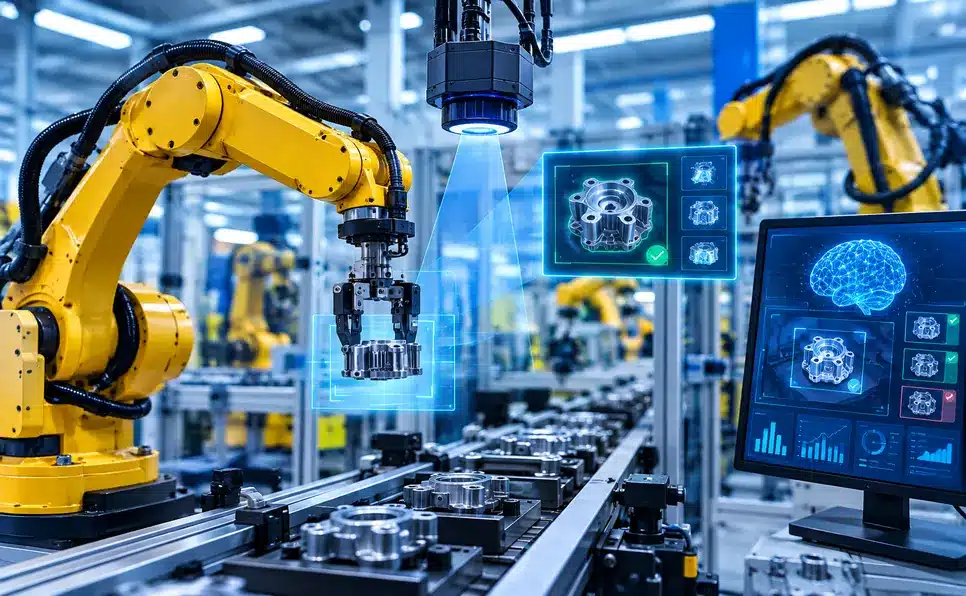
Cameras paired with vision software gave robots something closer to actual perception. Instead of trusting a fixed path, a robot arm with machine vision can look at a bin of parts dumped in randomly, figure out which one’s in reach, work out the right angle to grab it, and adjust on the fly if something’s not quite where it’s expected.
That sounds like a small upgrade until it’s watched in person. My friend walked me through a line where parts arrive in a jumbled bin — no neat tray, no precise placement, and the robot just sorts it out. A few years back, that same task needed a person standing there feeding parts in one at a time. Now it doesn’t.
AI is the part that’s actually new
Machine vision alone can “see.” AI is what lets a system start making judgment calls instead of just following rules someone wrote by hand. A vision system programmed with strict rules breaks the moment something unexpected shows up — a part with an unusual scuff, lighting that’s slightly off, a shadow in the wrong place. An AI-trained system, shown enough examples, gets better at handling the stuff nobody explicitly coded for.
The defect-detection side is where this shows up most clearly. Instead of a fixed checklist of flaws to look for, these systems learn from thousands of examples of good and bad parts, and they start catching things a rigid rules-based system would’ve missed entirely. My friend’s plant uses this for surface defects that used to need a trained human eye and a magnifying lamp. Now a camera catches it in under a second, and honestly, catches things the old inspectors used to miss on a tired Friday shift.
Autonomous manufacturing isn’t really about replacing people
This is the part that gets overstated in a lot of headlines. The goal on most factory floors isn’t an empty building running itself in the dark, no matter how often that image gets used in articles about this stuff. It’s closer to taking the repetitive, error-prone parts of the job — sorting, inspecting, moving material between stations and letting people handle the parts that actually need judgment: fixing what breaks, improving the process, catching the one-in-a-thousand problem nobody trained a system to recognize.
My friend’s job didn’t disappear when the vision systems went in. It changed. He spends less time untangling jammed bins and more time managing a system that mostly runs itself, which he’ll admit is a better use of a workday even if it took some getting used to.
The part nobody shows in the demo reel
Every slick video of a robot handling parts flawlessly skips the months of setup that made it possible. Training a vision system takes a mountain of labeled examples. Lighting has to be controlled carefully, because a shadow that looks irrelevant to a person can throw off a camera entirely. And integrating a new AI-driven system into an existing line, full of older equipment that was never built to talk to anything smart, is its own slow, unglamorous project.
My friend’s plant spent nearly a year tuning one line before it ran the way the sales pitch promised. Worth it, in the end, but nowhere close to the plug-and-play story that gets told at trade shows.
Where this is actually heading
The next real shift seems to be less about any single robot getting smarter and more about machines on a floor starting to coordinate with each other — one system flagging a defect, another adjusting its own pace in response, without someone in the middle relaying the message. That’s less flashy than a robot that can “see,” but it’s probably the bigger deal long-term.
For now, the honest version of this story is less science fiction and more steady, practical improvement: robots that finally notice what’s actually in front of them, and factories quietly getting better at catching problems before they turn into expensive ones.