
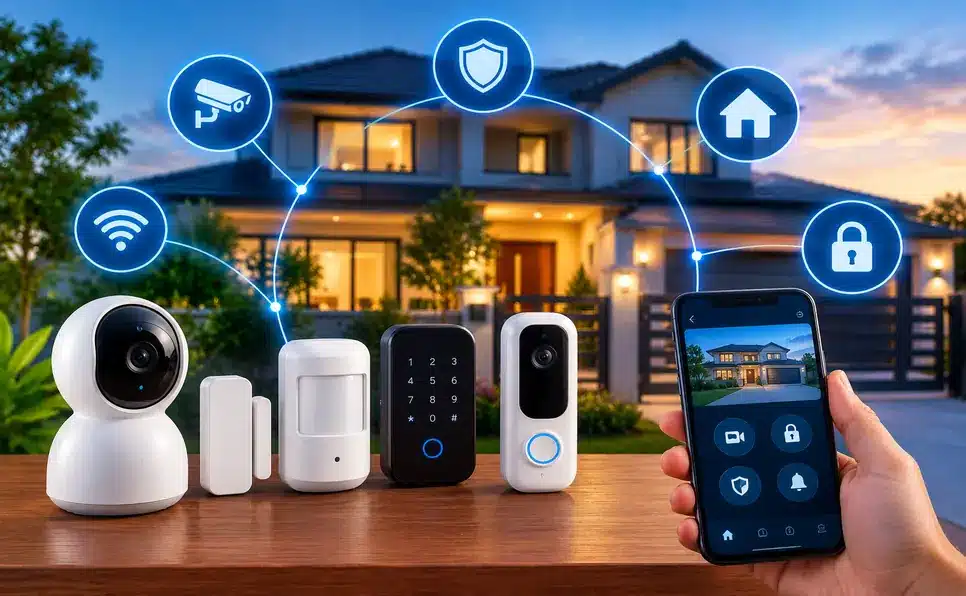
My uncle still has a sticker on his window from an alarm company that went out of business over a decade ago. He swears it works just as well as a real system. “Nobody checks,” he says. And honestly, for years, he wasn’t entirely wrong. A fake sticker and a loud dog used to be most of what passed for home protection on a lot of streets.
That’s not really the case anymore. Technology changed the math on home security in a way that snuck up on most people, myself included. I didn’t think much of it until I helped my sister set up her first apartment last year and realized how much had shifted since I last paid attention.
The sticker-on-the-window era is basically over
Here’s the thing about old-school deterrents — they only worked because people couldn’t easily check if they were real. Now anyone casing a house can glance at a doorbell camera’s little blinking light and know within a second whether it’s active. That cuts both ways. A real camera does more work than a fake sticker ever could, but it also means the fake stuff doesn’t fool anyone the way it used to.
My sister’s building came with a video doorbell already installed, which I assumed was a landlord gimmick until a delivery driver left a package with a note that said: “left by the plant, saw someone sketchy on the block earlier.” Turns out she’d caught someone testing door handles on the floor below two nights before, and word travels fast in a building with cameras everywhere.
Smart locks are the part people underestimate
I’ll admit I thought smart locks were mostly a convenience thing — no more digging for keys, fine, sure. What actually sold me was watching my sister hand her brother a code for the weekend she was out of town instead of mailing him a spare key across state lines. The code just stopped working Monday morning. No key floating around afterward, no “did I ever get that key back” conversation six months later.
The entry log turned out to be the sleeper feature, too. She didn’t think she’d care about it until her cleaner came early one week and she could just check the app instead of texting to ask. Small thing, but it removes a weirdly specific kind of low-level worry that used to just sit there unresolved.
Cameras aren’t really about catching criminals
This took me a while to really get. The value of a visible camera isn’t mostly the footage — it’s that almost nobody wants to be recorded trying a door handle. Most people casing a house are looking for the path of least resistance, and a blinking camera light moves a house off that list fast. The footage matters when something does happen, sure, but the bigger job is happening before anything does.
Night vision and phone alerts are nice additions on top of that, but they’re not the main event. A cheap camera that’s visible beats an expensive one tucked out of sight, in terms of actually stopping something before it starts.
The part almost nobody thinks about
Every one of these smart devices is also just a small computer sitting on a home network, and that part gets ignored constantly. A buddy of mine found out the hard way that his camera’s default password had never been changed, and a quick search online turns up entire lists of devices still running factory settings. Nothing happened to him, as far as he knows, but it was enough of a scare that he went and updated every password on every device in the house that same night.
Keeping firmware updated and using a real password sounds like the boring homework assignment of home security, and it kind of is. But skipping it quietly undoes a lot of what the hardware is supposed to do in the first place.
Technology didn’t replace the basics — it just stacked on top
This is the part that gets lost in a lot of the marketing. None of this newer technology works as a substitute for a solid door and a decent lock. It works as an additional layer sitting on top of things that have mattered for decades. A smart lock on a door with a weak frame is still a weak door, just a fancier one.
What’s actually changed is how much control and visibility a regular person gets without hiring a security company or learning anything technical. Setting an alarm used to mean punching a code into a wall panel and hoping it actually armed. Now it’s a glance at a phone from a different city, with a log of exactly what happened while nobody was home.
Where this leaves things
My uncle’s sticker still isn’t doing much, technology or not. But the gap between “doing nothing” and “doing something real” has gotten a lot smaller and a lot cheaper than it used to be. A decent camera, a smart lock, and a bit of attention to passwords cover most of what actually matters for most homes.
The rest — facial recognition, AI-based threat detection, all the stuff that sounds like it’s from a spy movie — is interesting, and some of it will probably matter in a few years. For right now, though, the basics done well still beat the flashy stuff done halfway, every single time.