
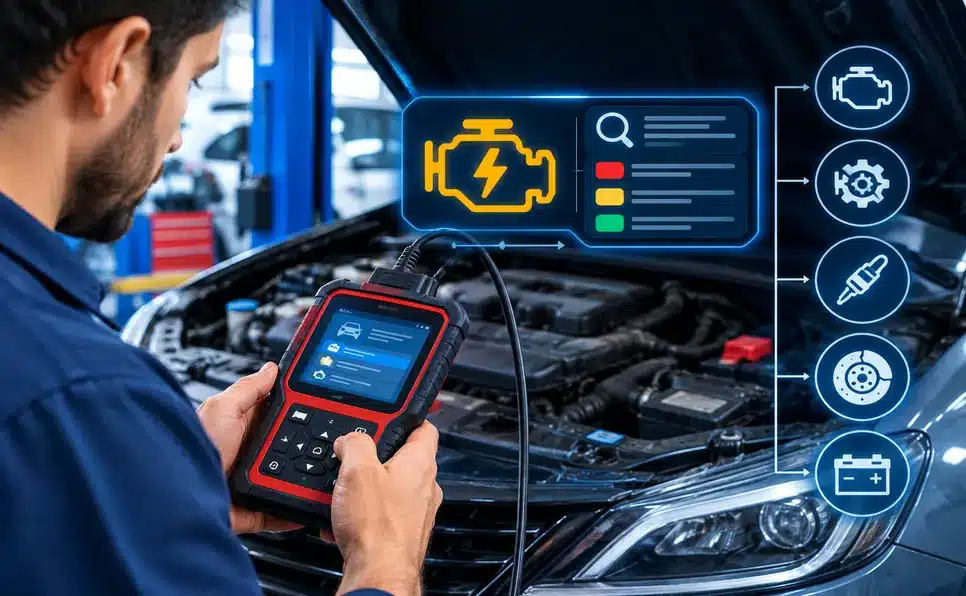
An automotive diagnostic trouble code (DTC) is a code stored by a vehicle’s computer when it notices something is not working within the expected range. These codes are used across many parts of a modern vehicle, including the engine, transmission, emissions system, electrical circuits, and communication networks. A scan tool can retrieve the code and give a useful starting point for finding the problem. However, the code itself does not always mean that the named sensor or component has failed.
That distinction is important because a diagnostic code is more like a clue than a final diagnosis. For instance, a code related to an oxygen sensor might be caused by the sensor, but it could also involve its wiring, connector, power supply, an exhaust leak, or another problem affecting the reading.
The right approach is to read the code, look at the vehicle’s symptoms and scan data, and then test the related system before replacing parts. Standardized Diagnostic Trouble Code definitions are maintained through SAE J2012, while vehicle manufacturers can also provide additional manufacturer-specific codes and diagnostic information.
What Does an Automotive Diagnostic Trouble Code Actually Tell?
Modern cars do a lot of checking in the background. While the engine is running, sensors and control modules constantly exchange information about temperature, air flow, fuel mixture, engine speed, emissions, and many other conditions.
The vehicle’s computer compares that information with expected operating values. If it detects a condition that does not look right, it can store a Diagnostic Trouble Code. Depending on the problem, the code may remain pending at first or become a confirmed fault after the system detects the condition again.
This is one reason a Check Engine light does not automatically tell the full story. The light tells the driver that the vehicle has detected something worth investigating. The stored code provides more detail about the system involved, but further diagnosis is normally needed to find the actual cause.
How Are DTCs Written?
Most standard OBD-II trouble codes follow a five-character format. The first character is a letter that identifies the general area of the vehicle involved.
P refers to powertrain systems, including the engine and transmission.
B refers to body systems.
C refers to chassis systems.
U is generally used for communication and network-related problems.
The numbers that follow provide additional information about the type of fault and the system involved. A code such as P0301, for example, is commonly associated with a misfire detected on cylinder 1. P0420 is commonly associated with catalyst system efficiency being below the expected threshold on many vehicles.
These examples are useful for understanding the format, but the exact diagnostic procedure can vary by vehicle. Manufacturer-specific information is particularly important when a code falls outside the generic range or when several systems are involved.
Why a DTC Does Not Always Mean a Bad Part
This is where many vehicle owners make an expensive mistake.
A scan tool might display a code associated with a particular sensor, and the immediate reaction is to replace that sensor. Sometimes that solves the problem. Sometimes it does nothing because the sensor was never the real problem.
Imagine a sensor is reporting a voltage that is lower than expected. The sensor could be faulty, but so could the wiring between the sensor and control module. A damaged connector, poor ground, blown fuse, corrosion, vacuum leak, or another mechanical issue could also produce a similar reading.
The code is telling the technician what the computer noticed. It is not necessarily telling the technician which physical component should go into the shopping cart.
That is why experienced diagnosis usually involves checking the related wiring, connectors, live data, and other conditions before replacing an expensive component.
What Happens When the Check Engine Light Comes On?
A Check Engine light can appear for something relatively minor or for a problem that deserves immediate attention. The seriousness depends on what the vehicle has detected and how the vehicle is behaving.
A steady warning light may indicate a fault that needs investigation but does not necessarily mean the vehicle has to stop immediately. A flashing Check Engine light can be more serious, particularly when it is accompanied by rough running or other symptoms.
If the vehicle starts shaking, loses significant power, overheats, produces unusual smells, or makes unfamiliar mechanical noises, continuing to drive should not be treated as a normal response to a warning light. The owner’s manual and professional advice are more useful in that situation than simply clearing the code.
The important point is that the warning light should not be ignored simply because the car still starts and drives.
How an OBD-II Scanner Finds the Code
An OBD-II scanner communicates with the vehicle through its diagnostic connector, which is commonly located underneath the dashboard. Basic scanners can retrieve stored and pending trouble codes, while more advanced equipment can provide live sensor information, freeze-frame data, readiness information, and manufacturer-specific diagnostic functions.
For a simple warning light, an inexpensive code reader may provide enough information to understand where the investigation should begin. A difficult electrical or drivability problem is another matter. Professional equipment can show considerably more information, which can save time when several systems appear to be involved.
The scanner should therefore be viewed as a diagnostic tool rather than a magic device that identifies the broken part.
What Is Freeze-Frame Data?
Freeze-frame data is particularly useful because it can show some of the conditions present when the vehicle recorded a fault.
Depending on the vehicle and diagnostic system, that information can include engine speed, temperature, load, and other operating conditions. It can help answer a simple but important question: What was the car doing when the problem was detected?
A fault that occurs only during acceleration may need a different approach from one that appears while the engine is idling. Without that context, a code can be much harder to interpret.
This is also why immediately clearing every code is not always a good idea. Clearing codes can remove useful information before the underlying problem has been investigated.
Should a Diagnostic Code Be Cleared?
Clearing a DTC does not repair the vehicle.
It simply removes the stored fault information from the control module, although the exact behavior depends on the vehicle and diagnostic system. If the underlying problem remains, the vehicle may detect it again and store the code after the relevant monitoring conditions occur.
There is another issue after codes are cleared: emissions-related readiness monitors may return to a “not ready” state. The vehicle then needs to complete its self-checks through normal driving conditions before those monitors become ready again.
This matters when a vehicle is being prepared for an emissions inspection. Clearing codes shortly before an inspection can leave the vehicle with incomplete monitors even if the Check Engine light is temporarily off.
Common Problems Behind Automotive Diagnostic Trouble Codes
DTCs can be connected to hundreds of different conditions, but some areas appear regularly in everyday vehicle diagnosis.
Engine-related faults can involve ignition problems, fuel mixture issues, misfires, sensors, and air intake problems. Emissions codes may involve oxygen sensors, evaporative emissions components, catalytic converters, and related systems.
Electrical faults can be more complicated because a damaged wire or poor connection can affect a component that is otherwise perfectly healthy. Communication codes can also appear when electronic modules have trouble communicating with one another.
Body and chassis systems have their own diagnostic codes as well. Depending on the vehicle, these can involve airbags, braking systems, steering, suspension, lighting, and other electronically controlled functions.
The growing amount of electronics in modern vehicles makes diagnostic information more important, not less.
How Modern Automotive Technology Is Changing Diagnostics
Cars have moved far beyond the days when diagnosis was mainly a mechanical process. Today’s vehicles combine engines and transmissions with sensors, electronic control units, cameras, radar, software and communication networks.
That development is closely related to the wider growth of AI in automotive technology, where computing systems are increasingly used for driver assistance, monitoring and other vehicle functions.
The same general shift can be seen in the Internet of Things and connected technology. Vehicles are becoming connected systems that collect information from many sensors and use that information to make decisions.
There is also growing interest in Edge AI technology because processing information closer to where it is generated can be useful for systems that need quick responses. Even with these advances, traditional troubleshooting remains important. Software may identify an unusual condition, but a technician still needs to determine why it happened.
When Is Professional Diagnosis a Better Choice?
A basic scanner is useful for finding out why a warning light has appeared, but it should not replace proper diagnosis when the problem is complicated.
Professional help becomes especially valuable when several codes appear together, the vehicle has severe drivability problems, the warning returns after repairs, or the suspected fault involves wiring, communication networks, or safety systems.
A technician can combine scan data with service information, electrical testing, and physical inspection. That approach is often much cheaper than replacing several parts and hoping one of them fixes the problem.
For vehicle owners, even knowing the DTC before visiting a repair shop can be helpful. It provides a starting point for a conversation without turning the code into a premature diagnosis.
The Real Value of a Diagnostic Trouble Code
An automotive diagnostic trouble code is most useful when it is treated as information rather than an answer.
The code tells a driver or technician that the vehicle detected a condition worth investigating. From there, the real work begins. Symptoms, freeze-frame data, live readings, wiring, connectors, mechanical conditions, and manufacturer-specific information can all help narrow down the cause.
Modern vehicles are becoming more complicated, so understanding this basic distinction can save both time and money. A code reader can tell where to start, but good diagnosis explains why the problem happened.
That is ultimately what makes automotive diagnostics useful. The goal is not simply to turn the warning light off. The goal is to understand the fault, repair the actual cause, and get the vehicle back to reliable operation.