
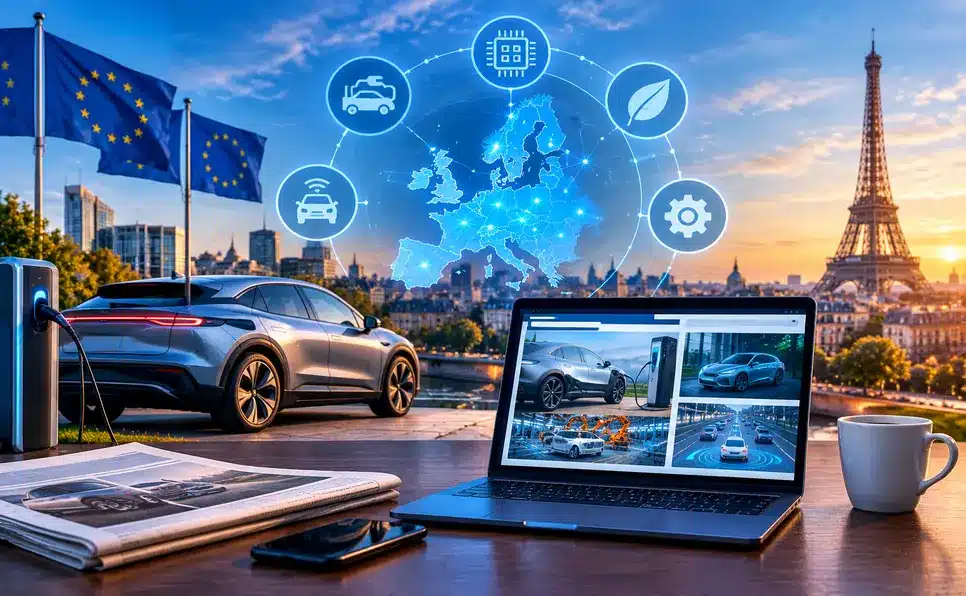
I seriously considered taking a trip to Paris this month to see the new Mercedes GLA. I think this says something about the state of car technology in Europe by the end of 2026. The Mondial de l’Auto, Paris’s big motor show, opens this month at Porte de Versailles, and this year it looks less like a car show and more like a software show on wheels.
The GLA is a decent example of what’s actually changing under the hood, or more accurately, on the dashboard. Mercedes is pitching close to 657 kilometers of electric range alongside something they’re calling the Superscreen MBUX setup, which bakes AI directly into the display rather than bolting it on as an app. I’ve sat through enough car reveals over the years to be skeptical of range numbers claimed at a motor show; those tend to shrink once real drivers with real traffic and real cold mornings get involved, but the direction is clear enough. For readers following Automotive Technology News Today, the bigger story is how range anxiety used to be the headline concern for EVs in Europe. Now it’s almost a footnote, with the actual pitch shifting toward how smart the car feels to sit inside.
Hyundai’s showing up in Paris too, with what the company calls major vehicle premieres, and it’s been busy elsewhere this fall as well. A couple of weeks before Paris, Hyundai Motor Group announced it had put something called a Data Flywheel into full operation, which is their term for a system that continuously feeds real driving data back into improving their autonomous driving tech. It’s not a flashy announcement on its own, no concept car, no dramatic unveiling, but it’s the kind of quiet infrastructure move that tends to matter more in three years than it does the week it’s announced.
A friend who tracks the industry for a living put it to me simply: the companies winning long-term aren’t necessarily the ones with the flashiest demo; they’re the ones building the pipeline that gets a little better every single week without anyone noticing.
Batteries are getting their own dedicated stage too, separate from the big Paris show entirely. E-Tech Europe runs in Bologna in early October this year, its fifth edition, and for the first time it’s happening in autumn instead of its usual spring slot. The event is specifically about advanced batteries and the production and recycling side of EV technology, which sounds dry until you remember that recycling is quietly becoming one of the biggest unresolved problems in the whole EV transition.
Nobody really wants to talk about what happens to a battery pack a decade from now, but somebody has to, and Bologna’s where that conversation is happening this year. The show’s folded into a broader Urban Tech event too, covering charging infrastructure, smart roads, and traffic management, which tells you battery tech isn’t really being treated as its own isolated thing anymore. It’s infrastructure now, same category as roads and power grids.
Here’s the part that doesn’t get nearly enough attention in the shinier coverage: European regulators have been quietly softening the path toward zero-emission vehicle mandates. The European Commission put out an automotive package back in December that, if it goes through as proposed, would ease some of the stricter emissions targets automakers were bracing for. It’s a meaningful shift, and not a small one. A lot of manufacturers had spent years planning product lines around hitting specific deadlines, and a softer mandate changes that math in ways that are honestly still shaking out.
One analyst on a forecasting call I caught wind of described it less as a reversal and more as Europe finally admitting its EV future isn’t going to look the same in every country, which tracks with what’s actually happening on the ground. Norway’s basically all-electric at this point. Plenty of other markets are moving at a fraction of that pace, for reasons that have more to do with charging infrastructure and price than any lack of interest in the technology itself.
That unevenness shows up in sales numbers too, and not in a way that flatters the legacy brands the way it used to. Volkswagen’s deliveries dropped something like seven percent in the first couple of months of this year compared to the same stretch before, and they’re not alone in feeling the squeeze. Chinese automakers have been steadily picking up market share across Europe, and it’s not just budget buyers switching over anymore.
The tech inside these cars, especially around software and in-car AI, has closed the gap faster than a lot of the established European brands seem to have expected. I talked to someone who works in product planning at a European manufacturer, who admitted off the record that the internal conversation two years ago was still mostly dismissive. That tone’s changed. Nobody’s dismissive anymore.
There’s also a quieter infrastructure story running underneath all of this that barely makes it into the glossy coverage. Charging networks across Europe are still wildly inconsistent depending on where you happen to be standing. A driver in the Netherlands or Norway can take fast, reliable charging for granted at this point, the way you’d take a gas station for granted a decade ago.
Drive a couple hundred kilometers into parts of Eastern or Southern Europe, though, and that confidence evaporates fast. Automakers love showing off range numbers at a motor show, but range only matters as much as the infrastructure around it, and that infrastructure gap is arguably a bigger barrier to adoption right now than anything happening with the cars themselves. I asked someone who does fleet planning for a logistics company about this, half expecting a diplomatic answer, and instead got a pretty blunt one: route planning across the continent still means treating half of Europe like it has reliable charging and the other half like it barely exists yet.
Autonomous driving regulation is its own slow-moving subplot too, and it’s easy to miss because nothing about it photographs well for a headline. Hyundai’s data flywheel announcement only means something in the context of what regulators will actually allow once the technology’s ready, and that approval process looks completely different country by country.
Germany’s been relatively aggressive about testing frameworks. Other markets are moving with a lot more caution, partly over genuine safety questions and partly over the messier legal question of who’s actually liable when a system makes the call instead of a person. Nobody’s fully solved that yet, anywhere, and until someone does, a lot of the flashier autonomous features stay stuck in demo mode even once the underlying tech is technically ready to ship.
What strikes me most, looking at all of this together rather than as separate headlines, is how much the actual story has shifted away from “will electric cars catch on” and toward something messier and more interesting. Range is basically solved, or close enough that it’s stopped being the main selling point.
The real competition now is happening in software, in how data gets used to improve autonomous systems over time, in who actually figures out what to do with a battery once it’s done its job in a car. None of that makes for as clean a headline as “new car goes 400 miles on one charge,” but it’s probably the more honest version of where the industry actually stands heading into next year.
I still might make it to Paris for the show, mostly out of curiosity rather than any real need to see a dashboard screen in person. But if I had to guess what actually matters out of everything happening across Europe’s auto industry this month, Automotive Technology News Today points to something more important than the cars on the showroom floor: the quieter developments happening around them, from a regulatory package easing in the background and a battery recycling conference getting more attention than it used to, to a data pipeline somewhere in Korea slowly making a car’s software a little smarter every week, whether anyone’s watching or not.